
You don’t need a degree to understand your adductors vs abductors, we’re going to give you a simple breakdown today. We’ll also talk more about how to train them and why they matter so much for your running.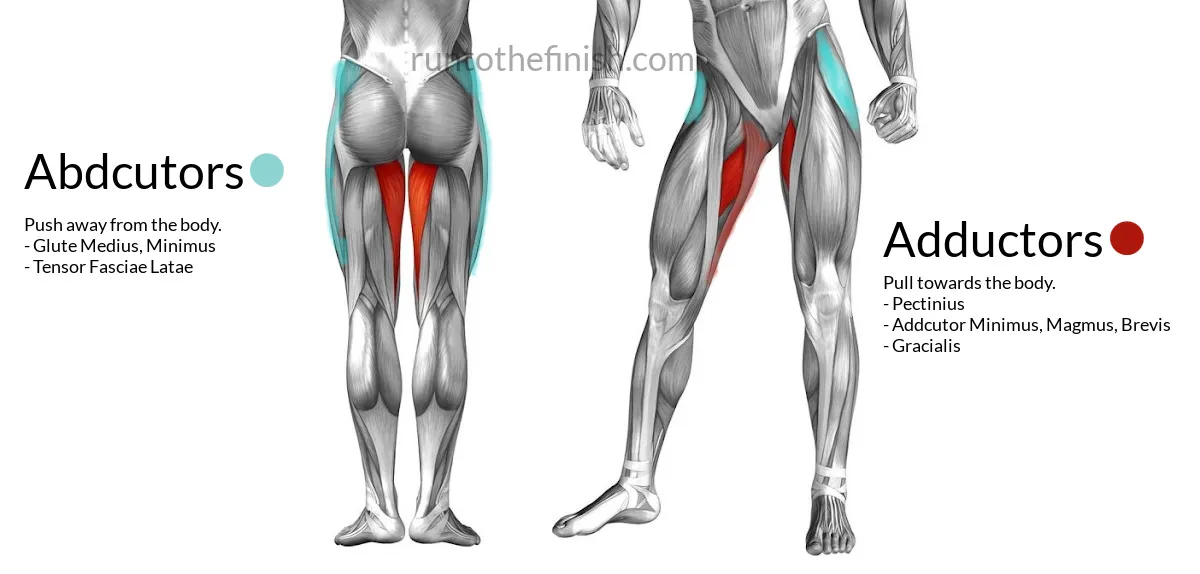
Yes, there’s literally only a one-letter difference between the words but the muscle groups do opposite things. We’ll give you some very easy ways to remember the difference.
The abductor and adductor muscles in your hips and thighs work together to allow side-to-side leg movements. Your abductor muscles move your leg away from the midline of your body, while your adductor muscles bring it back towards the midline.
While we talk a lot about glute strength training, these muscles are key for overall stability and additional power in your running. Plus, that side to side stability means if you have to jump up on a curb randomly the body is ready for it.
What are the Adductors?
The adductors are made up of the adductor longus, brevis, magnus, and minimus, as well as the pectineus, gracilis, and obturator externus. Whoo, that’s a mouthful! I promise there is no quiz.
This muscle group helps to stabilize the hip and pelvis and adduct the thigh (move your leg TOWARDS your body).
They’re also involved in hip flexion, extension, and rotation too. They’re mostly all located on the inside of the thigh.
There are a couple easy ways to remember the difference between the adductors and abductors.
- There are 2 d’s in adductors. One way to remember is to think of the second “d” as an abbreviation for “decrease.” The adductors decrease the space between your legs by bringing them together.
- Another way to remember the difference is that adductors “add.” They bring the legs together, adding one to the other.
What do the Adductors Do While Running?
Meanwhile, the adductors, while also important for stabilization, help with running efficiency, impaction absorption, and hip extension to power your stride.
We often associate the adductors with groin pain after running. A 2018 study looking at soccer players, showed those in the adductor strengthening group reported a 41% lower risk of groin problems compared to the control group.
While we aren’t making quick side to side movements, groin strains aren’t uncommon to runners and it looks like a little strength work might be the key to avoiding it!
In addition, they help keep your hips level as you run so your hips aren’t dropping to one side or the other. Weak adductors that can’t help with that stabilization can lead to injuries and issues throughout your kinetic chain, including in your knees, groin, and ankles.
It’s extremely important we not forget them when doing our full body strength training workouts.
Gluteal tendinopathy and lateral hip pain are some of the main issues runners may face, especially women.
“Running consistently places substantial load on these gluteal muscles and tendons,” explained Dr. Nelson. “If the frequency, volume, and intensity of runs exceed one’s capacity for recovery and adaptation, gluteal tendinopathy may develop.”
Dr. Nelson said usually when runners experience these issues, there is a training load imbalance. Basically, you’re engaging in more physical activity than your body can handle at a given time. However, it’s also important to be aware of your overall health. There are several lifestyle and metabolic issues that can impact tendon health, including diabetes, hypercholesterolemia, adiposity, and even the use of certain medications.
What are the Hip Abductors?
The abductors are on the outside of the thigh and are part of the glutes. They are made up of the gluteus medius and gluteus minimus. Strengthening these muscles help contribute to having a nicely shaped outer glute, aka your bum.
These muscles, as mentioned, help move your hip and legs AWAY from your body’s midline.
Dr. Alex Nelson, a physical therapist, offered an fun way to remember what the abductors do. “A quirky way to remember this is by thinking of “abduction” like aliens taking someone away.”
These muscles serve to stabilize the pelvis, particularly during single-leg activities, including walking, running, and climbing stairs.
What do the Abductors Do While Running?
Yes, you absolutely use these muscles to run.
The abductors are important to the stabilization of the pelvis during single-leg activities, a key component of preventing knee pain while running!
In fact, a 2011 study found that after just three weeks of hip abductor training, runners with patellofemoral syndrome (runner’s knee) experienced increased strength and reduced pain.
Adductor vs Abductor Exercises
You all know I love my dynamic running warm-ups and Dr. Nelson is also an advocate for taking the time to properly warm up before a workout or run. If you don’t know where to start, checkout these guided pre-run stretches to keep it dynamic and mobile, not static.
He also is a firm believer in focusing on effective load management, staying consistent with strength training, maintaining a regular sleep schedule, and proper nutrition.
He also stressed that research consistently supports strength training as a way to reduce sports injuries and reduce overuse injuries too.
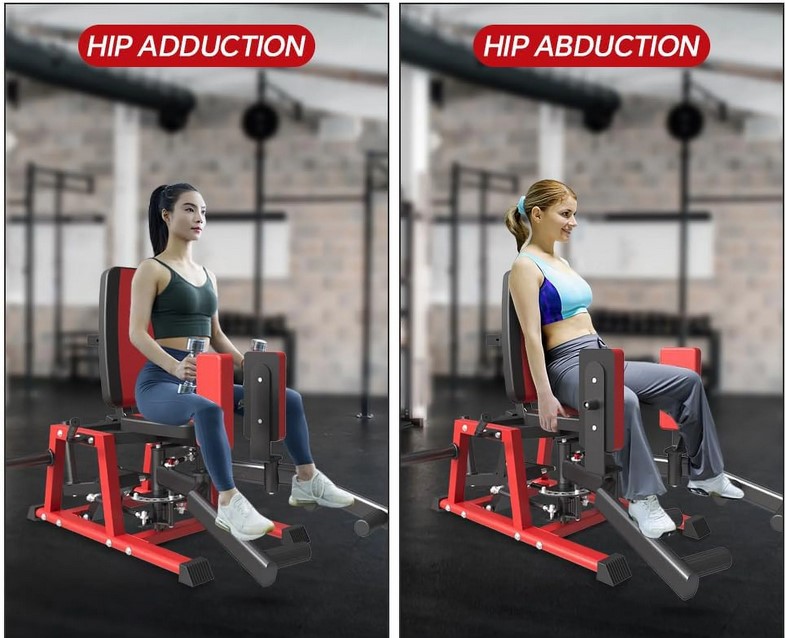
Should you use a machine focused just on hip adduction vs abduction.
you can, but it may not really be the most beneficial for a runner. We want to work on that total body stability with our movements. How your core engages while standing, vs just the targeted seated movement.
Additionally, there has been some discussion lately that these movements are just not aligned with how your body works so the movement is unnatural and could cause other issues. In general, for runners, we prefer other movements as the goal isn’t building size but overall strength and stability.
Moves that Work both the Hip Adductors and Abductors:
All of these moves are going to require your lower body to work together and will hit both adductors and abdcutors:
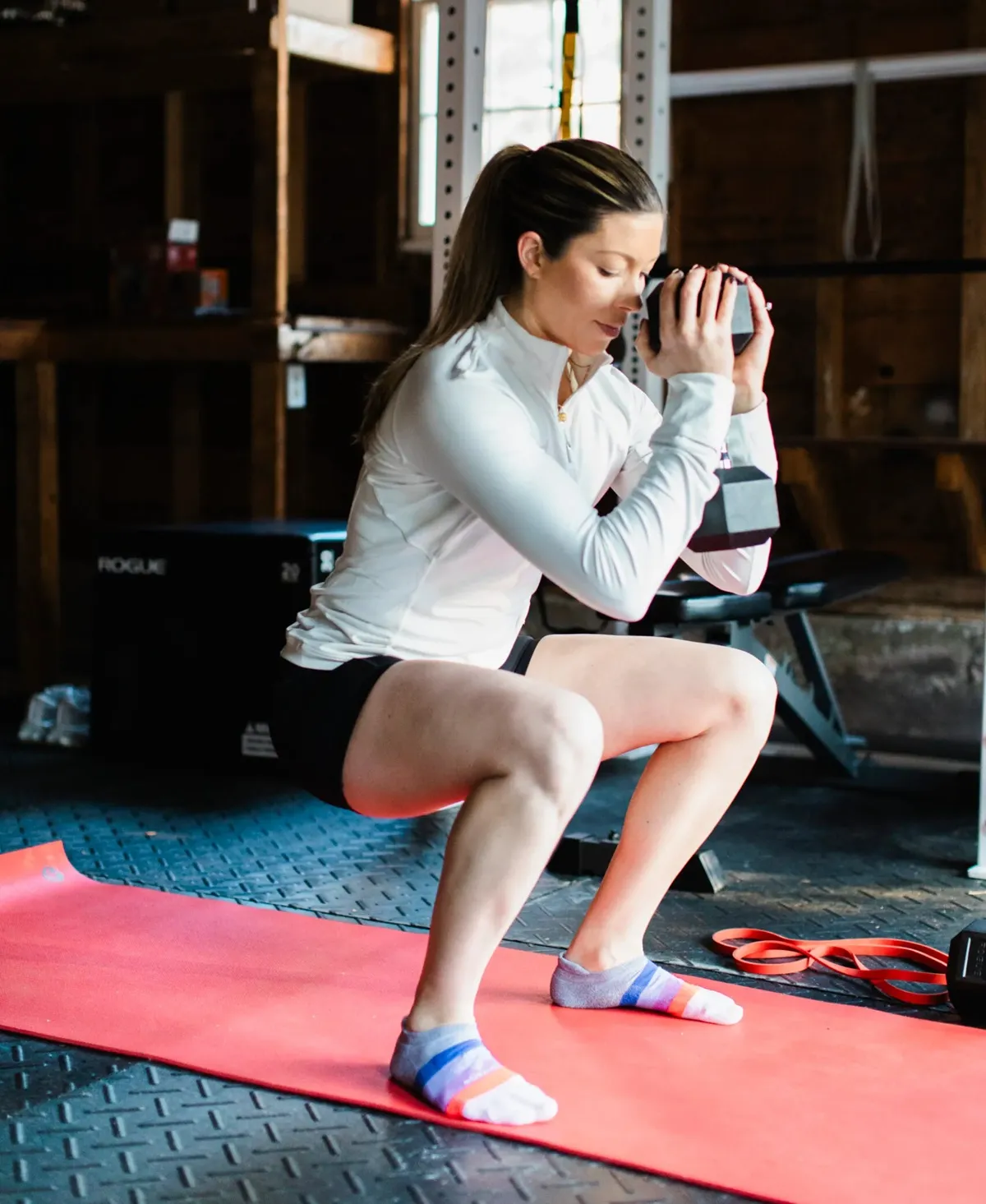
- Squats (can change range of motion to feel it in different areas)
- Forward and Reverse Lunges
- Step Ups
- Single Leg Balance (add in standing on an unstable surface
- Pilates – this will help with more endurance building, which is also important
Adductor Strength Training Movements
Here are some movements to target that inner thigh, adductor area:
- Lying side leg lifts – You might need to start here if coming back from an injury and high reps can burn!
- Copenhagen planks – Work through this from easy with bottom knee on ground, too both knees up, to straight legs
- Sumo Squats – Toes pointed outward and if holding a weight between legs, pause at the bottom
- Adductor Machine – You might think of this as the inner thigh machine where you are pushing the pads together (yup thigh master is working it too!)
- Side Lunges – Lateral lunges or side lunges are going to work both your standing quad and adductor
Abductor Strength Training Movements
Here are some movements to target that outer hip, abductor area:
- Fire hydrants – Standing with mini band above the knees, well pretend like your a pup next to a fire hydrant
- Curtsy Lunge – You can progress this both with weights and by using a step.
- Banded Lateral walk – Easier is band around knees, harder is band around feet
- Standing Hip Abduction – Great if you have a cable machine, otherwise mini band around the ankles, keep one leg stationary with slight bend and then lift the other straight leg out to the side
- Abductor Machine – Yup flip those pads around so that you are pushing out from the middle of the body
You did not see clamshells on this list because a few studies have shown they are inferior to most other movements for actually building strength.
Dealing with pain in either area?
Are you feeling tightness in your adductors or abductors after or during runs? What about other discomfort or pain?
If so, you might be wondering what to do next.
I, myself, have dealt with adductor issues and when rest didn’t solve the issue, I headed to the physical therapist for help. This is especially important if your pain is impacting your performance, affecting other daily activities, and simply won’t go away.
There’s only so much that stretching, rest, and anti-inflammatories will do on their own. In general, rest will NOT resolve a running injury.
“Tendons thrive on exercise and movement, but it requires the right progression,” said Dr. Nelson. “A physical therapist can guide you through the proper exercises, help you understand and monitor your pain, modify activities, and rule out other conditions.”
“It’s crucial to adjust the frequency, volume, and intensity of your runs to find a manageable starting point and load that you can recover from,” he said. “Finding this proper training dosage will be one of the biggest factors in reducing risk of injury and keeping the tendons feeling happy.”
It’s important to note that like many other types of injuries, there is no quick fix for tendinopathy. Recovery will take time and having someone guiding your rehab can prevent you from spending more time on the sideline than if you try to manage things on your own.
As a run coach, I can vouch for Dr Nelson and highly recommend you reach out if you’ve been struggling through a tendon issue!
Hopefully this gave you more than you expected on adductors vs abductors and now you feel more prepared to go out and strength train them the right way! Of course, our team of run coaches also provides custom strength work to our athletes if you’re still feeling overwhelmed with how to put all the running pieces together.
Other ways to connect with Amanda
Instagram Daily Fun: RunToTheFinish
Facebook Community Chatter: RunToTheFinish
Sign Up to Receive a Weekly Newsletter with Top Running Tips and Laughs



 Mizuno Wave Sky 9 Review | Max Cushion That Actually Feels Alive
Thanks for your article. It’s timely, since I’m currently working on some runner’s knee issues!