

The popular spring race weekend attracts runners from all over the country. If you’re getting ready to train for and run the Eugene Marathon, you need to read this post.
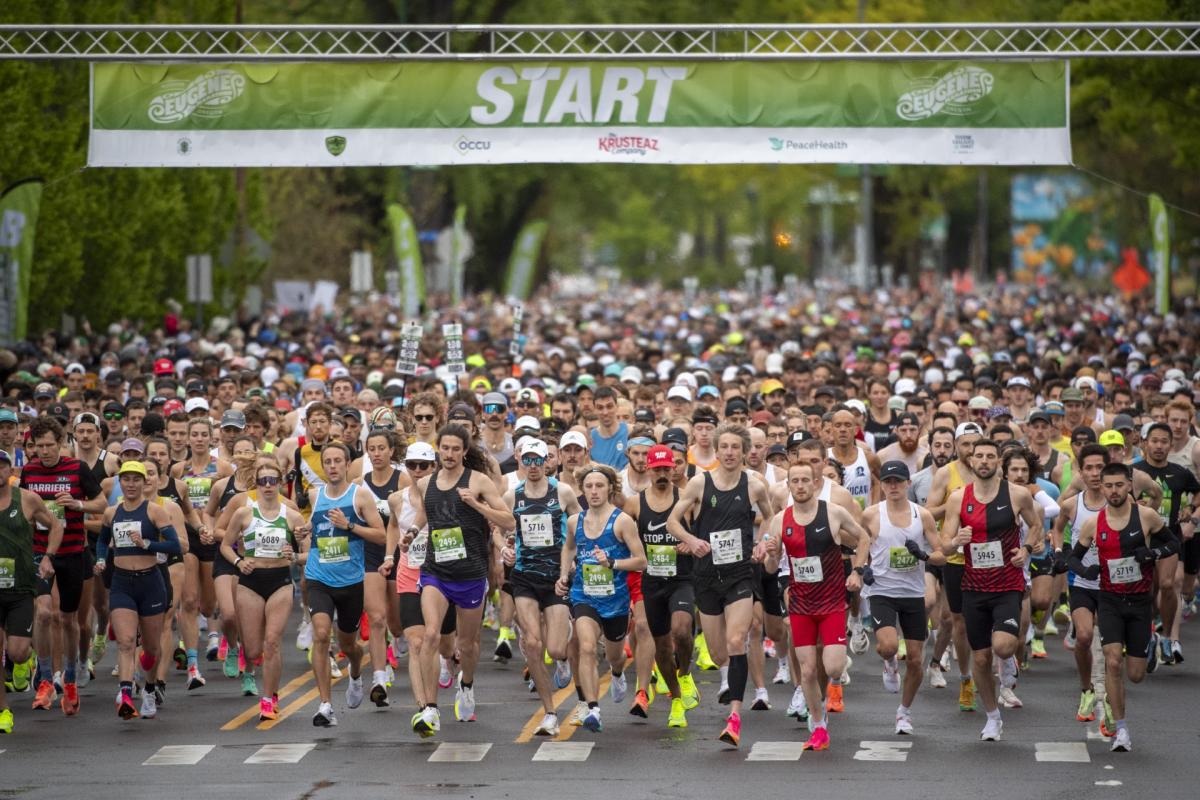
This is a popular race that runners register for in hopes of running a Boston Qualifying (BQ) time, but it’s important to note that the course isn’t pancake flat. There are actually a few hills throughout the 26.2 miles that you definitely want to train for.
Whether it’s your first marathon or you’re out to run a personal best, we hope these tips below will help you have the best day.
Once you start to realize how long it takes to train for a marathon, we hope you’ve started looking at the right plan! If you want a little extra support, our team of 10 coaches is here to help you!
Thank you to RTTF-coached athlete Darren Kikuta, who grew up in Eugene (plus a 3x Eugene Marathon finisher), for providing first-hand tips on having a great Eugene Marathon experience.
Eugene Marathon Tips
While it may seem like a big race if you’re looking at social media, the Eugene Marathon is actually on a smaller scale. In 2025, the entire weekend (marathon, half marathon and 5k) had a total of 10,724 participants.
The Marathon and Half Marathon are both held on the Sunday of race weekend. The two distances will run the course together until it splits around the 10.5-mile marker. This does mean that the course could be a little congested for the first chunk of the race.
The course brings its own unique set of challenges, while there may be a few hills sprinkled throughout, the biggest challenge is that the spectators are few and far between, especially miles 11-21.
But Darren made sure to note that the scenic views along the river make up for the lack of spectators. If you’re someone who runs with music, make sure you have a good playlist ready for the middle part of the race, just in case.
With any race, we have a few standard recommendations for our athletes:
- Try not to walk around a ton before the race
- Have your pre-race dinner and morning of meal with you or planned out, so you know it’s food you tolerate
- Don’t get sucked into driving the course :) You should have been training for whatever the elevation looks like and that’s all you can control
- Be prepared to hang around post race to cheer on other runners coming into the stadium
#1 Race Weekend Logistics
Like with any race weekend, you want to make sure you book your lodging as early as possible. There aren’t many hotels in the city, so you want to book early or consider alternative options.
If you find yourself staying close to the Graduate Hotel or in the downtown area, you’re not going to need a car. It’s super walkable and you’ll also have access to Bike Shares.
Plan ahead, especially with making reservations for your pre-race dinner. You can also map out grocery stores if you’re coming from out of town and want to be set for your carb load.
#2 Train for the Course
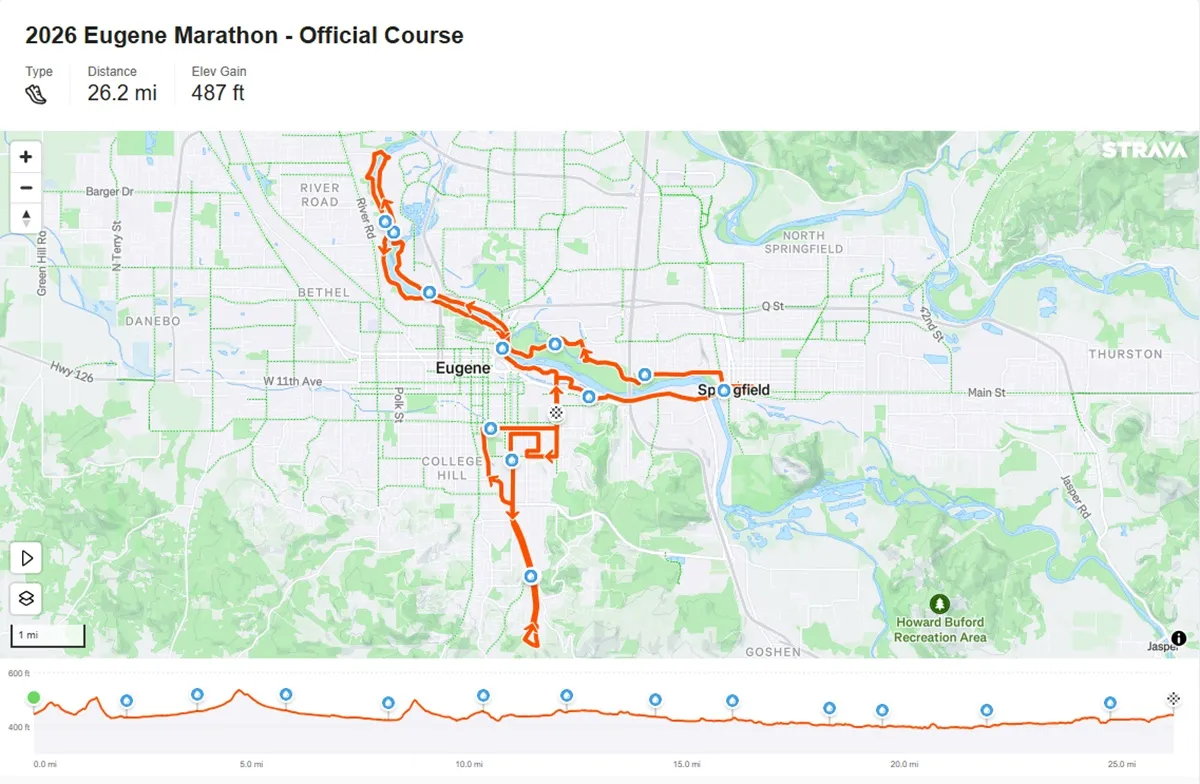
Yes, this is a fast course that a lot of folks set a BQ goal, but it’s important that you are prepared for a few hills in the first 8.5 miles.
Here are 7 Hill Running Workouts to Boost Your Speed and Endurance that you can add throughout your marathon training to be prepared. You’ll also want to add some hills to your longer runs so that you can get practice ahead of race day.
Don’t forget to treat your long runs like a dress rehearsal for the race. That means testing out everything from your fueling, hydration and even your race day shoes.
#3 Marathon Expo
There are many events and activations throughout the race weekend, especially at the expo. Remember, your job is NOT BE ON YOUR FEET ALL DAY.
The expo is located at the Graduate Hotel, 66 E 6th Ave, Eugene, OR 97401
Plan to be there for less than an hour if you’re just picking up your packet and doing a little bit of shopping.
The official merch is all Nike (the nearby Nike store does not carry a lot of race merch). You’ll usually find a sale rack of merch from previous years, always worth a browse. Plus no sales tax in Oregon!
#4 Plan for Race Morning
When: Sunday, April 26 at 7:00am
Pre-race shuttles will be available on race morning from 5:30am-6:40am. You’ll definitely want to take advantage of these depending on where you’re staying.
It’s not going to be like some of the bigger races, where you’ll need to arrive hours before the start of the race. Darren said that you can arrive at Hayward Field at 6:30am and still have plenty of time to get sorted for that 7 am start.
However, if you’re someone who would rather be there early and chill before the marathon, still go ahead and do that. Do whatever keeps those pre-race jitters at bay for as long as you can! Sit down, relax, maybe get in the porta-potty lines a few times, and visualize your race.
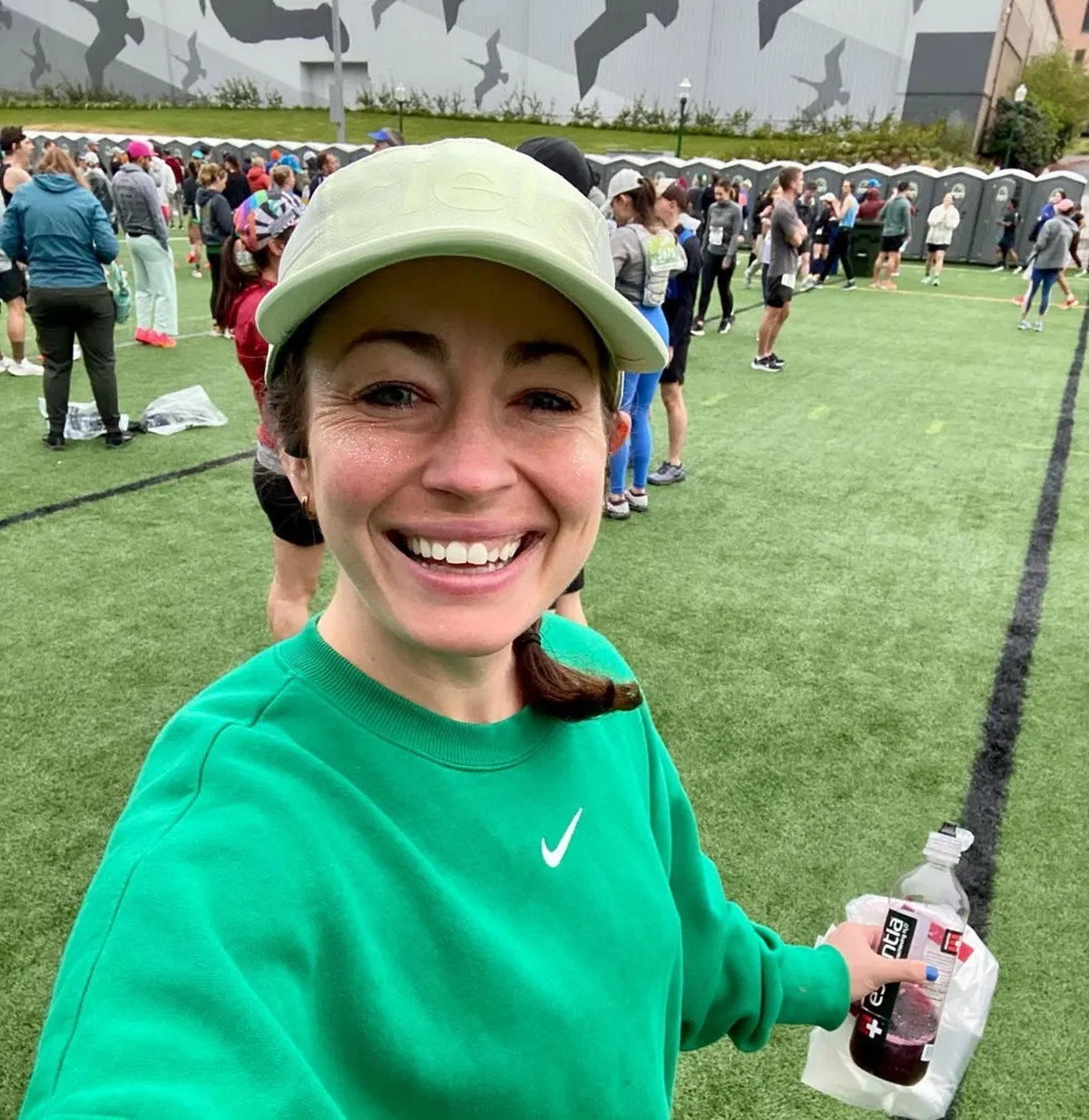
Gear check will open at 5:45am race morning. Make sure that you prepare your bag ahead of time so that it’s just a simple drop off race morning. This will be located in Finisher Field, west of Hayward Field.
Not sure what to put in your gear check bag? Check out this marathon checklist so that you’re fully prepared.
Corrals
You’ll be assigned a corral based on your estimated finish time entered during registration. You can move back but if you think you’re going to run a faster time, make sure you visit the Registration Troubleshoot desk at the Expo.
#5 Eugene Marathon Course Strategy
Let’s break down some of the important things to know throughout the 26.2 miles.
Course Support
You’ll find 12 aid stations throughout the course with water and Gatorade Endurance. There will also be special items at select aid stations (think bananas and GU energy gels). There will also be a few porta-potties every few miles along the courses.
Remember nothing new on race day, so if you do not want to carry a pack or handheld on race day, practice with what’s being offered on the course so that there are no surprises or unwanted bathroom stops along your 26.2 miles.
Miles 1-2
Since you’re going to be combined with the half-marathon runners, anticipate the course to be very narrow and crowded with lots of turns and small hills.
Be patient, settle into a groove and trust that things will open up considerably at mile 3.
Limit Your Weaving
No matter where you start in such a crowded course there’s going to be a need to pass people.
- Try not to make any massive weaves, this will add distance to your race
- Just move slightly to the side and keep going
- If you run in to a large pile up, it’s probably a pace group. Try to move to the side to get away from the pacer if you don’t like all the jostling.
Mile 3-5
This is going to be the first gradual uphill that you’ll experience on the course. It’s going to be from about miles 3-5. On the elevation map, the biggest hill is at 4.5 miles. It shouldn’t feel too hard. Remember to take smaller steps and pump your arms to get to the top.
Don’t waste all your energy sprinting or trying to hold goal pace going uphill. You’ll make up for that time later in the race.
Miles 5-7
Ah yes, what’s goes up must come down! This is where you can make up some of the effort you put into the uphill. Just set on cruise control for the gentle downhill here.
Mile 8.5
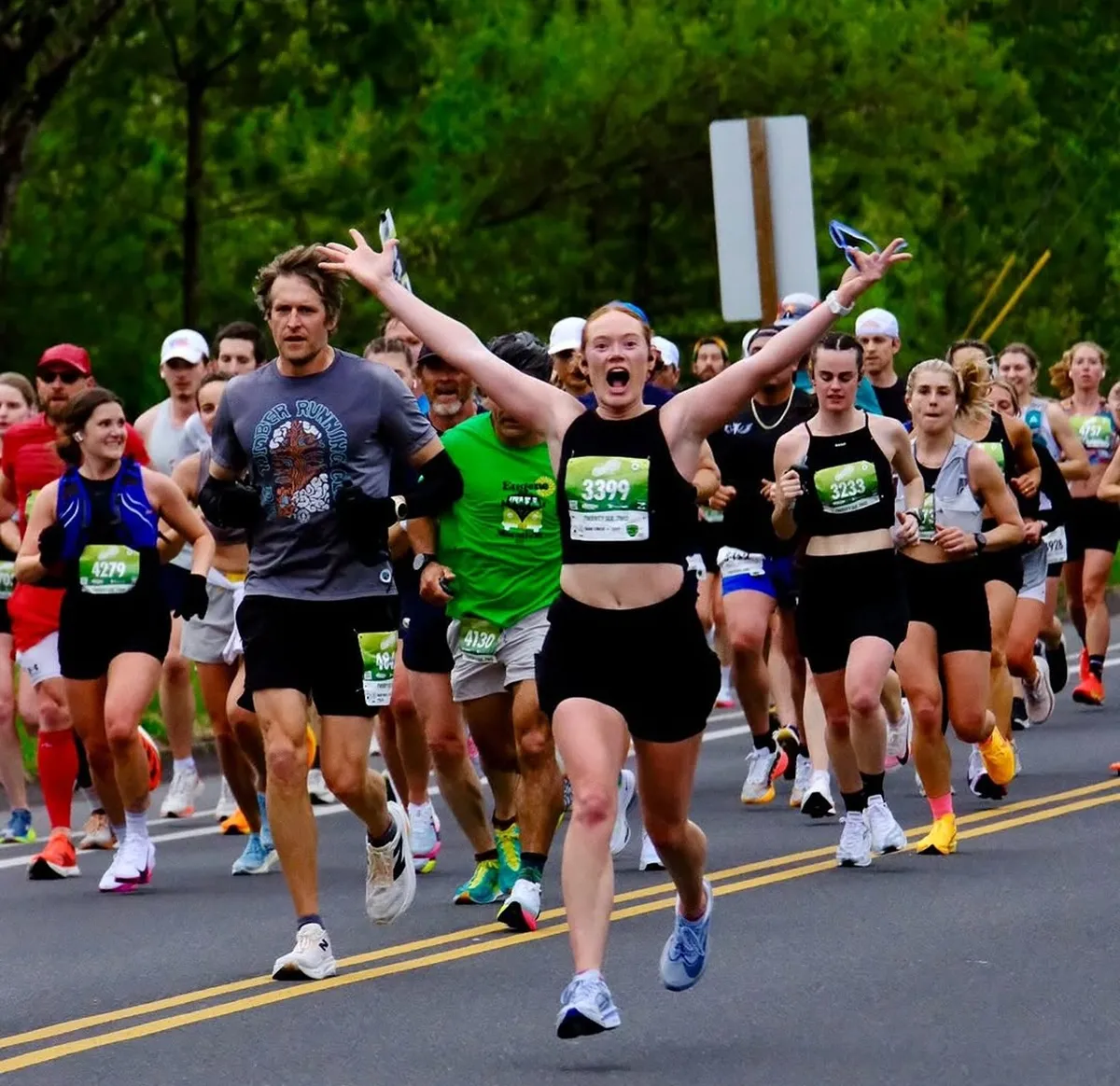
This is going to be the most challenging hill on the course. It’s still early on in the race, so again, it’s not the time to go all in and waste your energy.
To help prepare, add hills into your long runs and mid-week workouts. Practice running uphill during the middle of a run, practice your form and how to control your effort. The more you practice in training, the easier hills will be during the race itself.
And think of how running hills makes you a stronger runner, too!
Mile 9-10.5
No, you’re not seeing things. The course will loop back to where you started the marathon. This is also where the marathoners split away from the half-marathoners.
Don’t let your mind trick you into wanting to slow down the pace or throw in the towel. The fun is about to begin at the halfway mark, even though you’re so close to the finish line here.
Miles 11-12
This is where some mental grit is really going to come into play. It’s probably the most mentally challenging part of the course. It’s boring, it’ll start to get quiet, but keep telling yourself flat road is ahead! Put together a motivating playlist to stay focused.
Ask your friends and family ahead of the race for songs to listen to during the 26.2 miles. That way, you’ll think of them but also have something to look forward to.
Miles 15-16
Here is where you’ll pass the half-marathoners on the course; use this as an energy boost. Wave, give high fives, and shout some encouragement to each other.
Miles 16.5-20.5
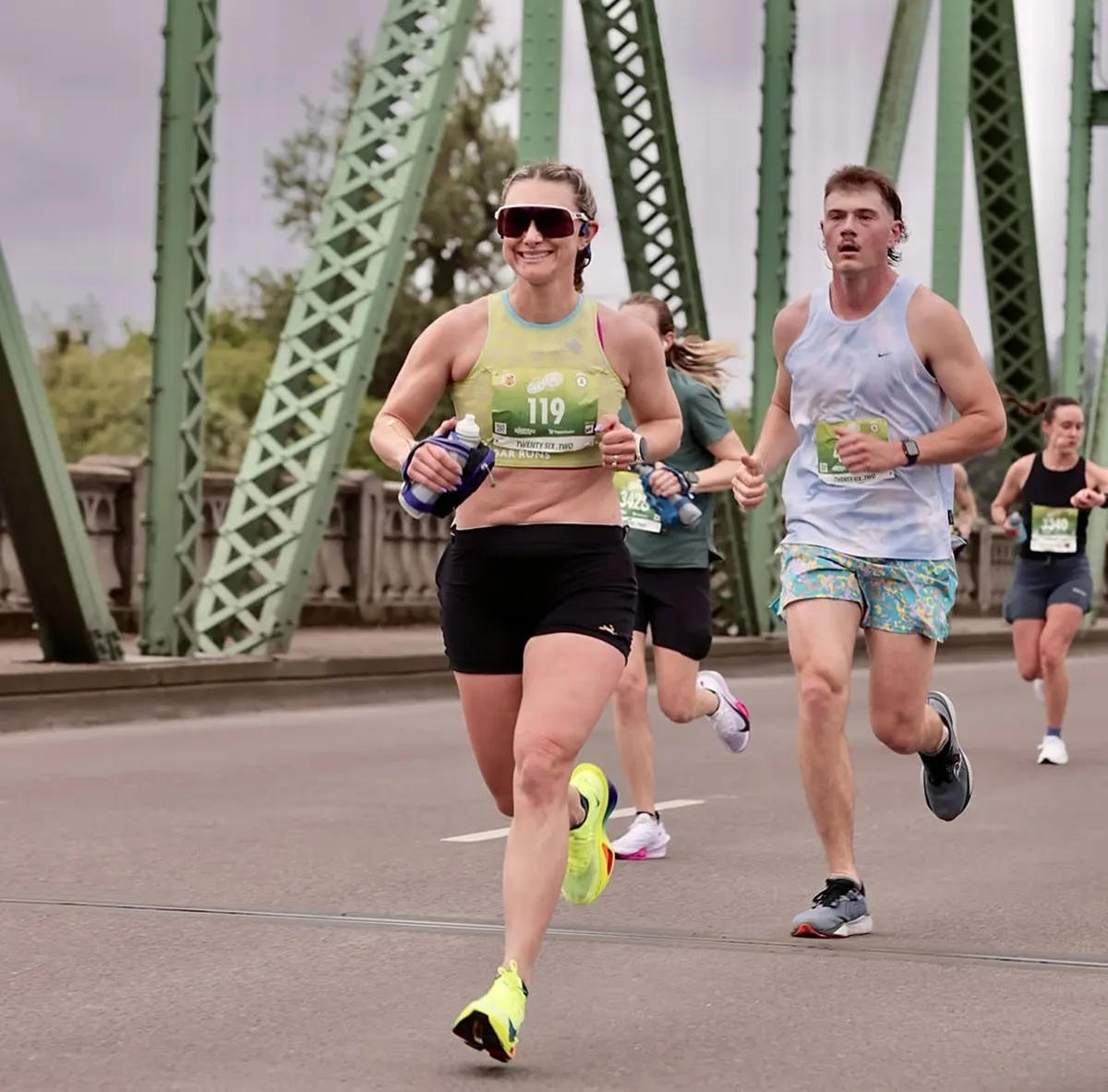
Miles 21-25.5
Still along the river, so take in the beautiful views while trying to ignore the fact that you’re running ever so slightly uphill. If you added hills into your training, this will feel like any other long run. Play mental games with yourself, instead of just the final 10k, think of it as two 5ks.
Mile 25.75
It seems like so many races add underpasses to the final stretch of their marathon courses. This is going to suck, especially when you just want to be finished, but once you get to the top you’ll see the Hayward Field column, and you’re 0.2 miles from the finish line
Final 200m
This is probably one of the coolest finishlines. The last push of the race brings you to Hayward Field track! Olympians and World Champions have run on the very same track!
Glance up to your right at the giant screen to catch a glimpse of yourself in the home stretch
Congratulations, you did it!
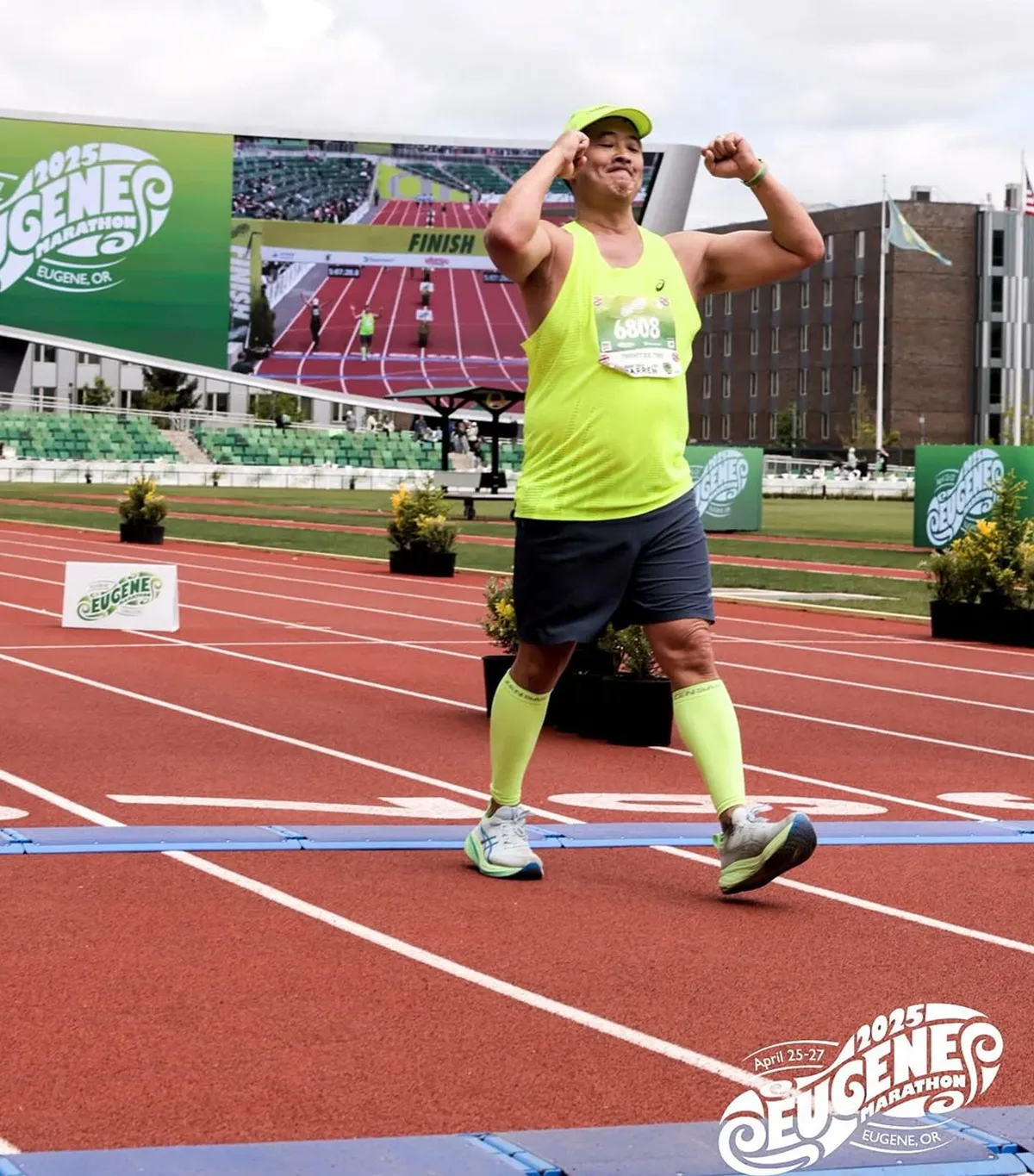
We hope that this list of Eugene Marathon tips was helpful.
Have you run the Eugene Marathon before? Are there other tips you think we should add?
Eugene Marathon FAQs
A few of your common questions as well!
When is the Eugene Marathon?
The Eugene Marathon is typically held the final weekend of April, and usually brings ideal spring weather.
Do you have to qualify for the Eugene Marathon?
No, anyone can register for the Eugene Marathon race weekend. It is a popular race for those trying to BQ.
How big is the Eugene Marathon?
The 2025 Eugene Marathon had 3,817 participants. The entire race weekend (Marathon, Half Marathon, and 5k) had a total of 10,724 participants.
Is there a cut-off time?
All participants must finish the marathon in 7 hours. To do so, you need to maintain a 16-minute-per-mile pace; if not, move to the sidewalk. The race will sweep runners after the race course is shut down to ensure the safety of all participants.
Can you defer your registration?
Yes, the Eugene Marathon allows deferrals during a specific time window. There’s a deferral registration fee to do this.
Can you change your race distance?
Yes, they allow transferring race distances if you need to drop down or want to run a longer distance (this is only if the races are not sold out).
Can you run with headphones?
Yes, as long as you’re able to hear what’s happening around you. You cannot use anything that amplifies the sound to disrupt runners around you ie. loud speakers
Can someone else pick up your bib?
Yes, they must have a copy of your registration confirmation email with the QR code.
Are there pacers?
Yes, they’re based on Boston Marathon qualifying times. Pacer groups range from 2 hours and 55 minutes to 6 hours, and a sweeper.
What to Read Next?
- Registering for Your First Marathon? Start With These Tips
- Best Marathon Shoes for Beginners Who Just Want to Finish Strong
- Best Non-Plated Race Day Shoes | Proof You Don’t Need Carbon to Run Fast



 Asics Gel-Nimbus 28 Review | Plush Cushioning Meets Surprising Durability


Leave a Reply