

Learning how to pace yourself while running or finding a good running pace is difficult for most runners. It’s super common to start races or runs like a rocket ship and then find yourself falling out of the sky before you’ve made landing.
Or perhaps you need to check your watch constantly to have any idea if you’re going too fast, too slow, wildly off pace, or nailing the goal?

Time to learn how to pace yourself. A big part of that is letting go of the idea that there is one good running pace. It changes based on where you are in training, but learning to go by feel is HUGE.
You can either watch the video at the end of the article with my top running pace tips to see them in action or read all about it below! Let me know what you find most helpful so that I can keep creating what works best for you.
8 Key Tips to Pace Yourself
If you’re trying to figure out how to get good at running, learning how to pace yourself is key.
The goal is to learn how to settle into a specific pace and run it from start to finish. This is called a steady running pace, and it’s the pace for most easy runs and even most of your long runs.
On easy days this pace needs to be slow enough not to cause your HR to spike the longer that you run. While on long runs, we’re dialing in to the pace you can hold from start to finish so as not to burn out.

Let’s dive into our 8 key tips for how to pace yourself while running.
#1 Run More Even Splits
Stop going out too fast and stop trying to speed up later! It’s better to be consistent.
Depending upon distance, pace and effort will change, but the ideal for each run is to start with the first mile being the slowest as your body warms up and adapts to the movement.
This is why a longer warm-up is recommended for shorter races (i.e. running a few miles before a 5K and just a few strides before a marathon).
Studies have shown that the negative split is LESS likely to produce PR’s than running a consistent pace throughout the race.
In order to do that one must spend a little more time practicing tuning in to the body during training and learning how different paces feel.
First this helps with goal setting and second, it leads you away from the watch.
Once you begin running by feel, it becomes easier to back off on planned hard days and push on planned easy days because you can trust your body.
#2 Use the Talk Test
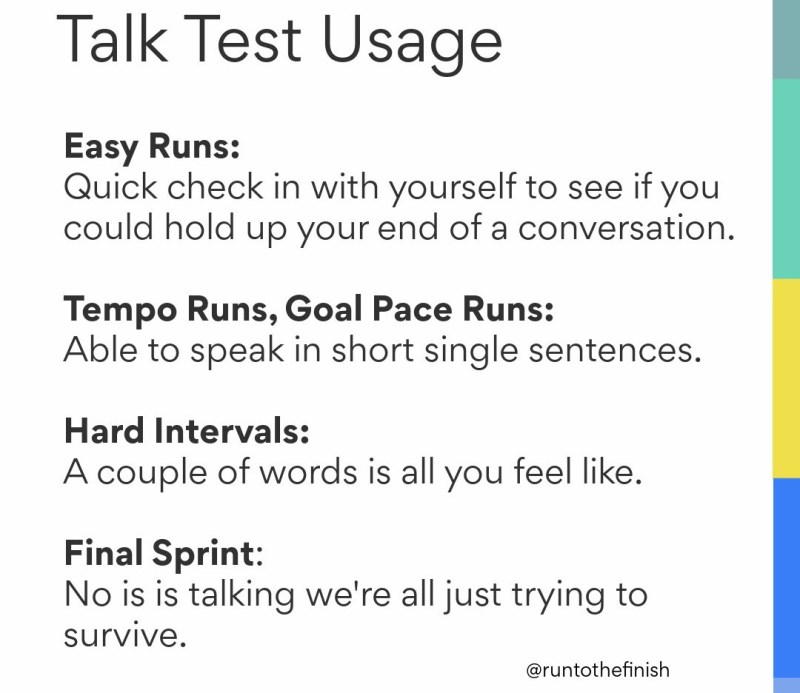
A more relaxed approach {and my preferred method} is to be aware of your breathing, your legs and overall feeling. This is often done via the Talk Test. Note if it changes throughout the run because you’ve started too quickly and use it to help you slow down when your goal is to add mileage.
The Talk Test has been studied and validated many times over.
You’re simply going to check in with yourself during the run to see where you land. It’s a very useful way to ensure you keep easy runs easy. The test uses the Pledge of Allegiance, but any 30ish word phrase is a good test for easy runs.
#3 Listen to Your Body
New runners often note that every run feels hard, so perceived exertion may be too hard to judge subjectively. Focusing on heart rate instead can help provide a solid number to track that is not pace.
Remember, we want you to tap into your body, not your watch.
Turn off the music and head out on at least one solo run per week.
Without distractions, you’re forced to pay attention to how the run feels…yes I know this might actually remind you that running is hard. Begin rating each run with the Perceived Exertion scale of 1-10 with 10 being a full out sprint.
Track your running RPE along with the final pace on your watch to begin making that correlation while you run.
This isn’t the same as training in heart rate zones or even low heart rate training. It’s simply a tool for monitoring to help you become more in touch with how different paces and efforts feel.
#4 Run on the Treadmill
It might not be your cup of tea, but treadmill runs help teach you what maintaining a specific pace feels like.
By setting the pace and then following it for a duration, you’ll notice quickly if you’ve been striving for a pace that’s too fast overall, maybe too slow or that being consistent feels different from your normal vacillating pace outside.
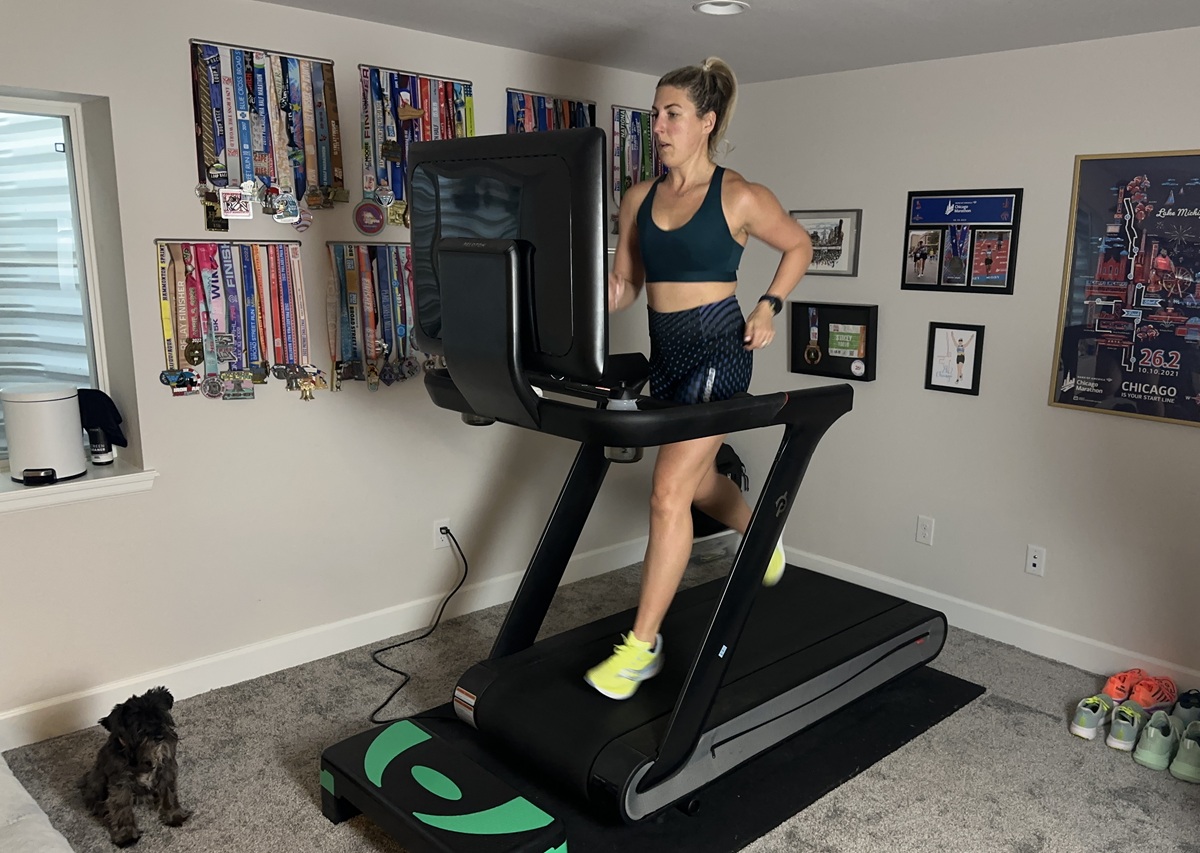
Too keep the boredom at bay, play with the incline and after each mile do a full body scan to begin creating muscle memory around the pace.
More tips on hitting your PR using the treadmill >>
#5 Add a Metronome
The ideal stride is to reach 170-180 footfalls per minute for optimal foot turnover. This is known as your running cadence and it’s a process to increase from your current rate, so don’t try to do it over night.
As you learn this system, you’ll begin to run more efficiently and again it takes the focus away from pace, giving you another measurement for gauging your run. iFit has a great metronome app you can download to use on your phone or try this clip on.
Once you’ve gotten in to a rhythm with this you can simply check in on it occasionally. Your 180 footfall will remain the same regardless of your running pace.

An easy way to check is as follows:
- Count your right footfalls for 10 seconds
- You want 15
- Which doing the math would take you to 180 per minute
Using a running app to keep you on pace, is much like setting pace goals on your watch, where it can beep at it you if you go over a certain pace. Helpful when you’re running those easy runs too hard!
#6 Keep a Positive Mindset
On any given day a run can feel harder or easier based on training, nutrition, weather and life. By looking solely at the watch a run could quickly be deemed good or bad, but learning to run by feel means you have the ability to adjust training.
Studies have also shown that often our perceived idea of how a run will feel impacts the entire body.
Spend a few minutes before each run {during that dynamic warm up} getting your mind right for either the intensity of a speed workout or the duration of a long run.
Remind yourself that you can lean in to discomfort to help your body change and that you can do anything for an hour.
Setting expectations about the run and tying those in to the feel of each pace ensures that on race day your able to keep pushing when others might pull back because you know where the discomfort lies and that you can pass it.
If you need some ideas for running mantras, we have an entire list put together for you!
#7 Run Interval Workouts
One of the things we often skip as new runners is varying our pace. We find a comfortable pace and settle in. Unfortunately, that pace often isn’t easy enough or hard enough to get the full benefit of the workout.
We call that “grey zone running”.
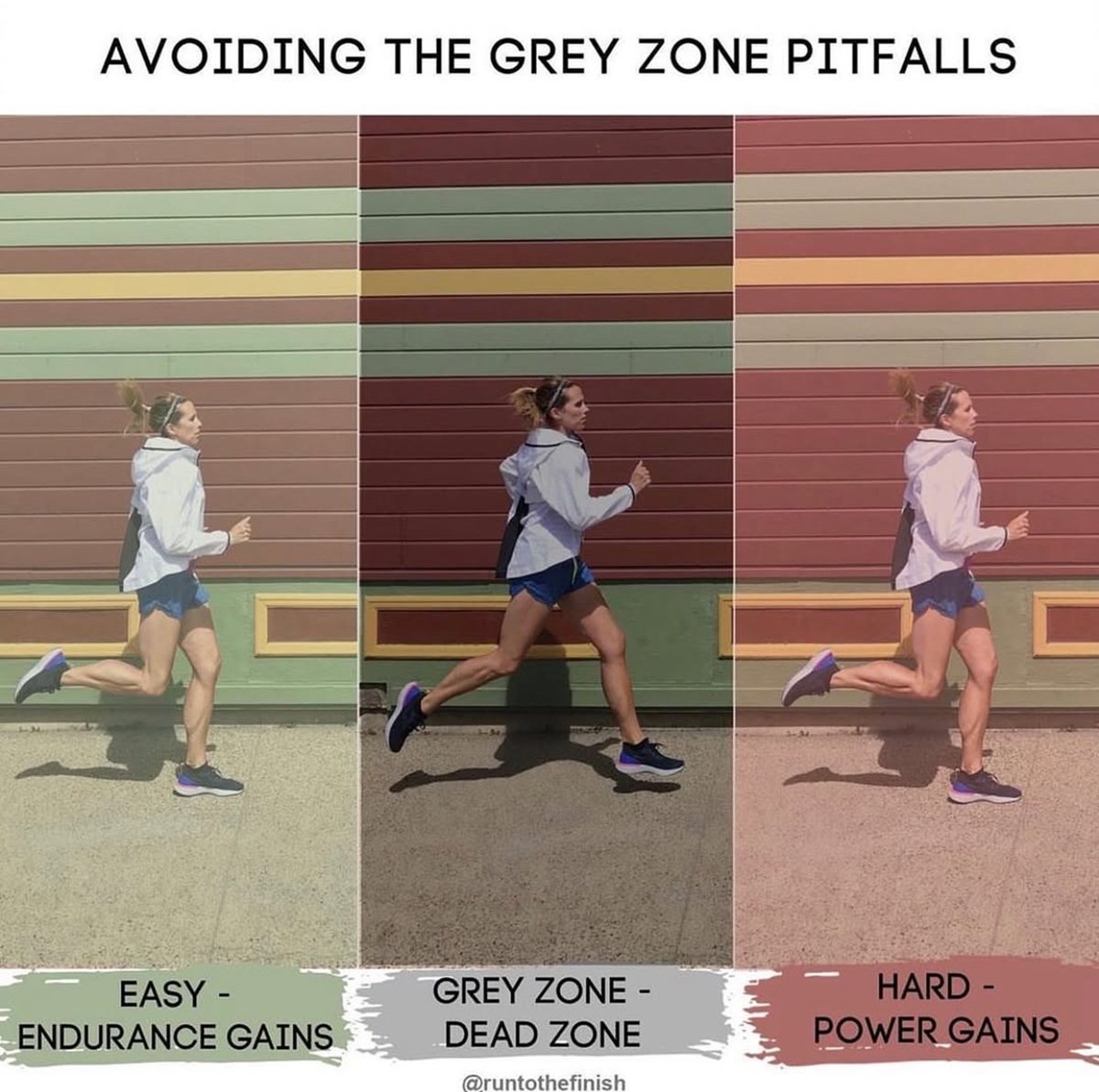
By throwing in some different types of interval workouts, you will begin to get a feeling for what is really hard and what is easy.
- Try run/walk intervals – this is the best way to build endurance
- Throw in some running strides at the end of your workout to get a few seconds at fast speeds
- Begin running hill sprints – the workout proven to make you faster
#8 Race Pace Workouts
One of the lessons I took away from Brain Training for Runner’s was to incorporate far more race pace miles in my training.
Looking back at most marathon training plans I noticed that most runs were faster tempo runs or much slower long easy runs than my goal pace. How on Earth are we supposed to maintain a pace that we haven’t practiced?
During the mid to later portion of a training cycle begin adding a few race pace miles to workouts during the week and then start adding more to every other weekly long run.
This will help ease some of your race anxiety and also help you become familiar with what pacing will feel like from a 5k to 26.2 miles!
What is My Training Pace?
Ahh now here is where things get tricky. You’ve set a race goal, which means you have a goal pace, but it’s important to remember that’s where you are going, not where you are. Plan to work towards that pace slowly over the months of training.
There are a TON of different training pace calculators out there to help you figure this out, but again remember they are guides and not tailored to where you are right now. They also depend on the type of training you’ll be doing.
For example, Hansons may be faster, while LHR doesn’t look at pace at all. Your run pace should be based on YOU, not what you think you need to run. Don’t get trapped in real runner syndrome.
- Goal Race Pace – what you are hoping to run in your next race
- Race Pace – Current race pace
- Easy Pace – Can be 60 seconds to 90 seconds slower than marathon pace
- Recovery Pace – Can be 90 seconds to 2+ minutes slower than your easy pace
80% of your running should be in that easy pace range when training for half marathon or marathon.
Hopefully these ideas gave you some new ways to think about how to pace yourself when running.
Looking for more training tips?
- Couch to Half Marathon Training Plan
- 12 Week Half Marathon Training Plans
- 10 Mile Training Plans
- Why Does Treadmill Running Feel Harder
Other ways to connect with Amanda
Instagram Daily Fun: RunToTheFinish
Facebook Community Chatter: RunToTheFinish
Get more running tips: Pinterest



 5 Best Manual Treadmills
Great tips! I’m terrible at keeping a consistent pace. I start off slow and steady than think I’m too slow and speed up, than slow down, than check my watch and speed up, than heart rate spikes even higher so I slow down. I really hope to get things under control this coming year, but I think I need to focus on adding in more running to do that. Definitely going to keep these tips in mind.
I’d say my mind is my biggest enemy to keep a pace running. When I was training for my 5K PR I would get laser focus to hit my tempo runs. If I let my mind wander… I just slowed down for no good reason! haha!
Yeah I’m the same way, to me running is like a mental game. If my mind wanders, I’ll slow down. My goal is to do 1.5 miles in 12-13 minutes . Good luck with your 5k.
awesome tips . I love 5 k’s . I don’t desire to do longer. I do however love to just go run 5 or 6 miles but have lots of issues with sciatica and loss of feeling in my foot. Aside from that. If I jut out in a race I’m going too fast for my own breathing. I love the fact you mentioned the mind. Running is a mind game.
I do think treadmill running helped me with steady pacing over the years. What’s funny though is that I find I’m quite a bit faster outside than I am inside on the treadmill because when I’m on the treadmill, seeing that pace go up almost freaks me out and triggers “I can’t run that fast, at least not for more than a minute!” even if I’m usually running that pace or faster when I’m outside. Weird, huh?
The mind games we play are so crazy!
I’ve been running 5k for a really long time and never knew you’re supposed to do longer warm up for that (smh) I’m gonna try this. Also, I’ve always been on the more race pace runs instead of the only run race pace on race day mindset, because you have to know what race pace feels like so you know you’re doing it on race day.
That’s such a great point!! It’s something I feel like fast runners do with short distances and then suddenly marathon runners totally skip practicing goal pace.
Love the idea of the metronome for learning to pace yourself. Learning to trust your body seems at the heart of it all. Thanks!
Agreed…we need to set our mind
I believe that following your own pace is very crucial! Your tips are so important and astonishing! Keep up the awesoem work.
Being forced to run without my watch has been a GAME CHANGER for me ! By running without my watch and focusing on how I feel I’ve managed to PR in the 5K and the Half!
Yes!! I totally find when we don’t look at the watch on race day, we often allow ourselves to go faster because we aren’t mentally thinking it’s too fast.