

Can you maintain muscle while being a distance runner? If often touted as the unattainable, the no way it’s possible and all the bro’s are going to tell you that “it kills your gains”. But is that actually true? Certainly looking at sprinters we know it’s not true, so let’s see what it means for distance runners.
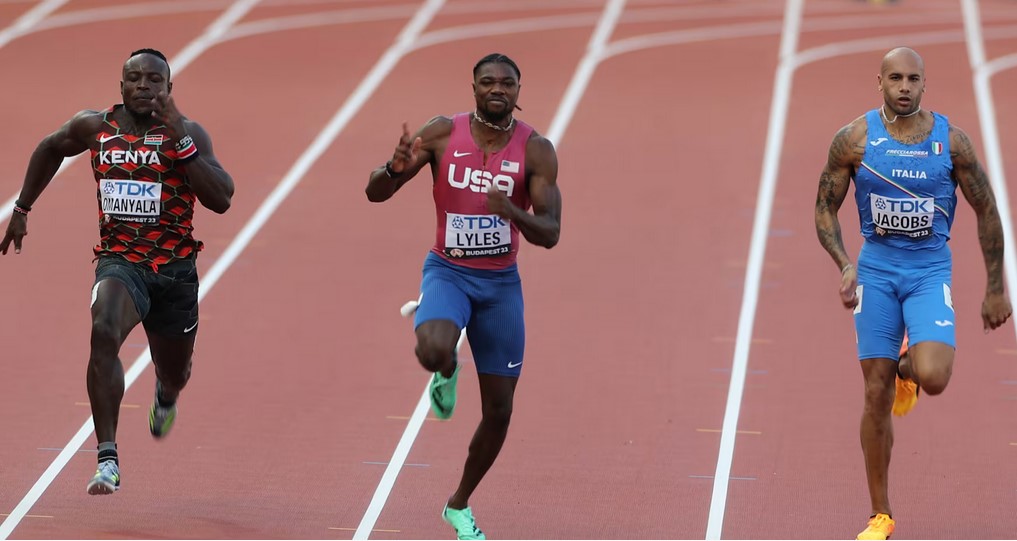
While the elite marathon runners you see are often very tiny and not heavily muscled, does that mean it applies to all of us?? As a running coach and someone who has been at this for over 2 decades, the answer is absolutely not.
Most of us are not running 120 miles per week. The only way to gain muscle and run that much is to eat an incredible amount and train with a split focus, which would go against their major goals. Of course, they’re strength training, but not with a get bigger focus.
In this article, we’ll cover everything there is to know about building muscle when running. And take a look at what you can do to gain muscle if you’re a distance runner training for a marathon.
Because who doesn’t want to become their fittest self, run stronger and stop getting injured? This applies to runners of all ages, so don’t dash away my masters runners!
Does Running Build Muscle?
First things first – does running build muscle?
Absolutely! I’d dare you to look at most toned runner legs and say that it doesn’t build some muscle. This is particularly true for newer runners and those newer to fitness.
Distance running can help to build lean quads and calves, but is not likely to help you build larger muscles. You’ll often see more powerful-looking muscles on sprinters because the body is looking for all the strength it can find to propel it quickly forward (and they train heavy weights to assist that).
The body wants to remain lean for distance running because less to carry means it’s more efficient.
But of course, that’s only part of the story!
You’ve got to be doing some things right to ensure that you’re building and maintaining muscle when you start increasing your mileage over 20-30 miles per week.
To understand this better, let’s first look at how muscle is built in our bodies.
Understanding Muscle Building
Muscles are built by doing exercises that use tension to create tears in the muscle, which break it down. Combine this tension or stress with recovery, and your body starts adapting by building muscles that are stronger to better handle that workload next time.
Another way to explain this would be that muscles are built in the body when muscle protein synthesis exceeds muscle protein breakdown.
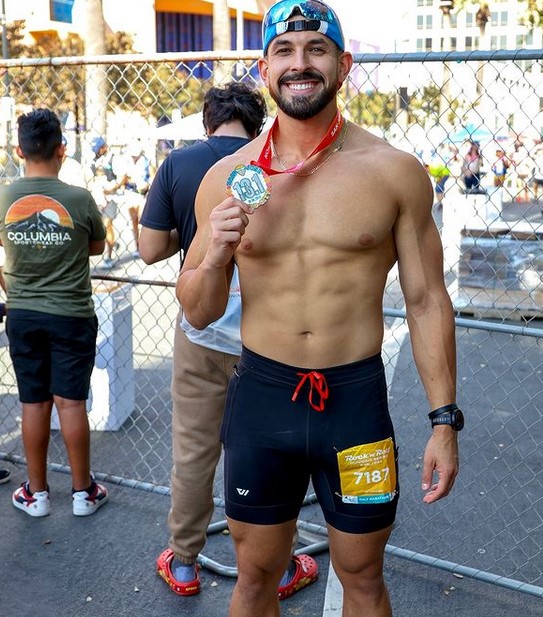
Xavier Jimenez known as TheBuffNurse on Instagram has been showcasing his intense training in the gym alongside is running and knocking out 3:28 marathons. What it proves is that it’s possible…and that for MOST runners we need to start by building muscle BEFORE increasing mileage.
Step 1: Stress the Muscle
Stress or tension occurs whenever you work your body harder than it’s used to, which includes anything from weight lifting to adding hill sprints to your training program.
Undergoing this type of physical stress while working out breaks down the tissues and fibers in your muscles.
Your body then repairs or replaces these damaged muscle fibers through a cellular process where it fuses them together to form a new muscle protein strand.
Step 2: Appropriate Recovery
Want to take advantage of that breakdown, then recovery is where the adaptation occurs. Recovery is where you actually get stronger and maintain or gain muscle. You can’t just keep pushing the breakdown, if there’s no recovery you aren’t going to make progress.
Recovery doesn’t only mean sleeping (but getting sleep should be a top priority). It’s also fueling.
For most runners that means putting a higher emphasis on protein intake than you might have in the past. We know especially for our masters female athletes that this is going to make a difference.
A rule of thumb often shared is to aim for 1gram of protein per pound of bodyweight, yes even up to 200grams. As noted above, if building muscle is your goal then you likely want to be in a bit of a calorie surplus.
Again, this doesn’t mean carbs don’t matter!
Step 3: Progressive Overload
Feel like you’ve been lifting consistently, but haven’t seen any changes.
Time to review if your program really has a progressive overload to it. You can’t do the same lunges with the same weights week after week and see progress. You’re going to need to increase the weights, increase the reps or change the tempo.
You don’t need to confuse your muscles or do any crazy moves. The basics are going to take you a very long ways.

11 Tips to Build Muscle As a Runner
“Can you build muscle while simultaneously marathon training?”
This is hard and very very hard.
I am a HUGE proponent of running and lifting both at the same time, but I believe it would do distance runners a world of good to temporarily reduce mileage (yes below the average 30+ miles), and focus primarily on building solid muscle.
We call this our base building phase before going in to marathon training.
After you’ve built more muscle, you’ll be stronger for your runs to prevent injury, you’ll most likely be faster, and you’ll be able to eat more (which is always a winner).
1. Build Muscle Before Increasing Mileage
If you want to combat muscle loss during marathon training, step one is to actually build some muscle prior to diving in to the super long runs.
Yes, that’s going to mean spending some time lifting heavier, instead of out on the roads. This is a really great time to have a full base building cycle. That means you are still running!!! You’re just also prioritizing your strength training when it comes to hours in the week and energy availability.
While not our favorite place to be, we’ve talked a lot about how strength training can improve your running by engaging your core, making your arms more powerful (it makes you faster!) and eliminating potential injuries!
2. Do Running Workouts That Build Muscle
Another way to work towards a net muscle gain would be to aim for a growth hormone spike.
According to a study published in the Journal of Applied Psychology, growth hormone spikes tend to last longer after performing endurance training.
An increase in Growth Hormone is going to tell your body that it can and should build more muscle. Hence the reason people dope with it. But we’re going to use some natural methods to take advantage of your workouts.
Here are a few running workouts to encourage that GH spike:
Sprint intervals: These incorporate fast-twitch muscle fibers and help you look and appear stronger.
High resistance interval running: Run with some form of resistance, e.g., on an incline or a hill run to encourage your body to build more muscles.
Long-distance runs: These will engage and incorporate your slow-twitch muscles to help them build further. Run at a continuous pace for a longer period of time to build these types of muscle fibers.
Your training routine might be very different from other runners, but the key to building and maintaining muscle when running is to constantly challenge yourself sustainably and by mixing up different types of runs.
3. Lift Heavy Weights
Even as a running coach, I admit I was slow to pick up on this one. We’re so focused on the run that we don’t want to compromise it by feeling sore.
But a number of studies, from the Strength and Conditioning Journal and others, have shown that “heavy weights (e.g., 3-5 sets of 3-6 reps at ≥85% 1 repetition maximum)…. can improve economy and endurance performance by increasing muscle power production”.
Which is why at the very beginning I wanted you to think about heavy weights and lots of strength in terms of base training.
If during that time you can get in more heavy days, you’ll have more power going in to your marathon cycle and can then drop down to maybe 1-2 heavy days and shorter lifts.
It’s also the only way to build muscle. High rep training is going to further increase your endurance, but you have plenty of that. We want to build muscle.
- Try alternating days with lower reps heavier weight and higher rep lower weight
- 3 rounds of 5 reps at a heavy weight is proven to build muscle faster
- Heavy is relative to YOU and where you are at
- Repeat workouts, so you can see if you’re getting stronger
- Once you have built up to 8-10 reps, then increase the weight again
- Try going heavy for 3 weeks and then a week lighter to come back fresh
Checkout our 12 week guided heavy lifting for runners program >>

4. Be Specific With Training To Build Muscle while Running
Once you get in to race training, you’ll want to shift your workouts to be more specific to running.
Do strength training that makes sense for running. For example, you really don’t have to push sleds or flip tires or kettlebell swing unless you plan on doing those in a competition (CrossFit is a different story).
Every run has a purpose. Your long run is to get used to the mileage and build endurance. While a recovery run is designed to move easy without additional breakdown. Purpose.
When you look at your strength training workouts, focus on the one’s that will also make you a better runner: Glute workouts, core workouts, upper body with TRX.
👉We have a number of runner specific strength training programs available now >>
5. Work with the Right Coach
A number of our runners found that working with a running coach like, Coach Kaitlyn or Coach Amy, who have a lot of experience working in gyms and programming both strength and running, helped them hit their goals.
While we’ve had other runners come to us from coaches who wouldn’t provide them with anything more than some basic strength work and found they just never could progress on their goals.
Look around for a personal trainer who has a good knowledge of what runners need or a running coach with a great strength background. This is going to ensure that you get through both base building and marathon training with the right type of workouts for your goals!
6. Eat in a Surplus
Muscle building requires excess calories. That’s just a fact.
So if you are cutting calories, while lifting you’re not going to build any muscle. Stop looking at the scale for awhile and really focus on the goal of become a stronger, fitter, healthier runner.
This is where we start to get into the idea of macros for runners and protein timing for fat loss.
I’ve linked to both of those articles, but I think it’s really important that we not get too caught up in measuring food, as that leads to other issues. Instead, our goal is to look at the day and make sure we’ve taken in enough good food!
7. Recover with Carbohydrates
Obviously, this can’t be stressed enough. You need to be diligent that after every single run, you are taking in carbs to refill those glycogen stores.
If you don’t refill them, then after they’re emptied out, the next place your body goes is muscle. My rule of thumb is to add 50g of carb per hour of running on your long runs (so if you run 2 hours then add 100g carb).
Consuming the right type of carbohydrates is essential. Not all carbs are the same, and some are definitely better for you as a runner than others.
So, what are the best carbs for runners? I have a post that explains just that and more!
Not sure about what to eat? Checkout these 30 post run meals!
8. Hit that 30 Minute Recovery Window
Especially for my masters runners, anyone over 40, you MUST start focusing on nutrition within 30 minutes of your workouts.
After long runs, the body needs that fuel to tell it not to go looking for your muscles. After strength training your body needs that protein to help it actually build muscle.
It’s much harder to build muscle the older we get, so we have to take advantage of that time.
Dr. Stacey Simms has shown for women especially in peri and post menopause, refueling with that mix of carbs and protein within 30 minutes helps tremendously with fat loss and maintaining muscle.
Aim for 30 grams of protein in that recovery meal. If you just can’t stomach food, the next tips is for you!
9. Eat Enough Quality Food
I think that many people end up not eating enough, which again means eating away at muscles not just fat. Because we often start running to lose weight, there’s a calorie counting mindset that can backfire.
As your mileage increases, if the body is not receiving enough fuel it starts to utilize your muscle for power those runs.
Though you might continue to lose weight on the scale, it’s not unusual to start having that “skinny fat” look because you’ve lost muscle tone.
You’ve got to make sure that you are getting enough and there have been many times that I’m forcing more food at the end of the day sometimes just to make sure that I know I’m properly fueled.
Are you hitting 7-9 servings of fruits and vegetables? Are you eating enough protein for your body to rebuild after all the work it’s putting in?
10. Remember It’s Not All About Mileage
A lot of runners are surprised to find that by adding in strength workouts, they can often decrease their weekly mileage while getting faster and feeling better.
But this often takes us some time to do because we have been focused for so long on hitting a certain number of miles each week. Or believing that a certain set of miles makes us more of a runner.
- Get specific about your goals
- Pay attention to how your workouts are contributing (not just to hitting arbitrary numbers)
- Run test races to see how your new strength training is paying off
- Allow yourself to enjoy the strength (I swear this a mindset issue a lot of runners have)
BONUS 11 – Creatine
This alone is a massive topic, but one that now has so much research behind it that we must add it to the list! It’s no longer bro science, there are real results and it’s extremely safe for pretty much everyone.
Here’s my detailed article on creatine for runners, so you can better understand the benefits and how to use it.
Does Running Burn Muscles?
Does “cardio kill your muscle gain”? I’ve heard this a lot from gym bro science, so let’s start here.
No, it does not.
A 2012 study in the International Journal of Sports Medicine found that the group who incorporated both strength and endurance “optimizes the magnitude of muscle hypertrophy, maximal strength and endurance development”.
Unless a runner is consistently underfueling, which is a massive problem with female distance runners. Or a runner is undercutting their protein intake significantly.
Outside of those two things, there is no reason for the human body to start burning and consuming its own muscle.
Our bodies want to primarily burn carbs and fat before they start burning protein because both are easier to break down and release energy.
For this reason, if a runner is consuming its own muscle stores, they;re either not consuming enough protein or carbohydrates. Later in this post, we will also look at the right nutrition for runners to help build muscle.
Have you ever focused just on muscle building?
Do you feel like you lose muscle during marathon training?
Other ways to connect with Amanda
Instagram Daily Fun: RunToTheFinish
Facebook Community Chatter: RunToTheFinish
Sign Up to Receive a Weekly Newsletter with Top Running Tips



 Salomon DRX Defy Grvl Review | Like a Gravel Bike
I’m a guy and a freshman in college and I’ve always been really skinny and have wanted to build more mass overall. Unfortunately, in recent months I’ve been noticing excess fat in my chest (moobs) and under my chin. This is a problem because I still look super skinny in all other respects. I’ve considered running to burn off this fat, but I still want to get bigger overall and I’m afraid that I won’t be able to do that if I run. Any advice?
This is something that I needed to read. I love running and it is the original sport I did when I was first losing weight. This issue is that I want to bulk up and develop muscle but I am too obsessed with running to stop and build mass instead. I was always told that I needed to cut the cardio and eat the right foods and I suppose it was true to some extent after reading this article. Thanks for the advice.
Will never miss those carbs again after a run, don’t wanna lose my muscles after all. Great page!
I have a quick question – when you say ‘add’ carbs (50g per hour of long run) do you mean in addition to a normal daily meal routine, or just in that recovery meal/shake/etc?
I’m a marathoner training for my first 100 miler and I do crossfit 3xweek (run 4 x week), and i’m finding I have to be constantly vigilant with upping my mileage, recovery and just enjoying fun workouts at crossfit. I think I’m maintaining my strength but losing muscle as my long runs increase and the weeks of high mileage build up, so this article is coming at a helpful time!
Great post! I am so guilty of skimping on the strength training. I mostly do bodyweight strength training at home but I definitely need to get back into the gym a couple days per week. I’m towards the beginning of my half marathon program, so now would be a good time to incorporate extra workouts while my mileage is lower. https://runningmybestlife.com/half-marathon-training-diaries-week-1/