

Fueling your body adequately by knowing what to eat before a half marathon can make all the difference between hitting the wall halfway through and finishing strong. We’re not just talking about race morning, but your race week plan.
By strategically planning your meals and snacks, you can enhance your endurance, improve stamina, and prevent the dreaded fatigue that can hinder your performance.
You do indeed need to look at carbohydrate loading, pay attention to your hydration, know when to stop eating fiber and plan ahead for any race travel. It doesn’t have to be complex, but it does require that you spend some time thinking about it just like you have your training for the last 3-5 months!
Remember, half marathon success is not just about putting one foot in front of the other; it’s about equipping your body with the right tools to conquer the distance.
So, let’s dive in and learn how to fuel for success and achieve your personal best in your upcoming half marathon.
Do You Need to Carbohydrate Load for a Half Marathon?
Research shows that carb loading for any endurance event over 90 minutes leads to performance improvements. For those running faster than 90 minutes there are still benefits, but you may only need 1 day of loading.

The half marathon, a 13.1-mile (21.1 kilometers) race, falls within the category of endurance events. This distance pushes the boundaries of human capacity, demanding sustained effort over an extended period.
Whether you are a seasoned runner or tackling this distance for the first time, comprehending the physical demands of the race is essential for effective pre-race nutrition.
During a half marathon, your body primarily relies on aerobic energy production, fueled mainly by carbohydrates and fats.
Carbohydrates, stored as glycogen in the muscles and liver, play a pivotal role in providing readily available energy during prolonged exercise.
As you run, your muscles break down glycogen to produce adenosine triphosphate (ATP), the energy currency of the body. However, the body’s glycogen stores are limited, and the rate of glycogen depletion varies depending on factors such as exercise intensity, duration, and individual fitness levels.
When glycogen levels become critically low, you might experience a sudden drop in energy levels, muscle fatigue, and a significant decrease in performance. This phenomenon, often referred to as “hitting the wall,” can be a significant obstacle to overcome during a half marathon.
Hence, we want to go in to the race with a body that is fully stocked and then we want to keep feeding it to keep that energy flowing!
Let’s start by looking at the overall picture of the week and then more specifically race morning.
What to Eat the Week of a Half Marathon
Let’s start with the idea that the majority of runners are not doing carb loading correctly and likely don’t need to make a drastic shift in their diet.
We don’t want to do new things on race day…why would you want to make massive changes to your normal habits the week of the race?
- Eat normally until 2-3 days before the race, that’s when you start to carb load
- Continue eating fiber up to then and then still include some to keep things move
- 3 days before the race make sure at least 50-60% of your calories come from easy to digest carbs
- 2 days before the race again aim for at least 60%
- 1 day before the race see if you can get closer to 70-80%
I’ve seen some recommend up to 90% of your diet in those days be from carbs.
But for most runners, I find that volume has felt overwhelming or they’re just craving some actual substance through protein. So be less tied to the number and more focused on rest, recovery and not walking all day in the expo.
MUST READ: AVOID these seven carb loading mistakes >>
Note: If you have not practiced any kind of carbohydrate loading during your training, you very well could feel bloated from this. Which is why like all things, it’s great to test out some loading before your long training runs. See how much different they feel and figure out what foods feel best for you.

What are easy to digest carbohydrates?
Easy to digest carbohydrates don’t mean sugar and sweets. Though they are delicious, we don’t want to increase inflammation or cause energy swings (but also don’t fear these foods!!).
- Fruit Juice – one of the few times we’ll recommend it here because usually we want the fiber of a smoothie, but right now we want the easy carbs
- Bagels – or I love sourdough because it often helps to calm the stomach due to the fermentation
- Rice – white rice has less fiber
- Potatoes – go crazy with regular potatoes or sweet potatoes, just watch the butter or heavy fats the day before the race
- Oatmeal – throw in some ground flax for extra anti-inflammatory goodness
- Pancakes, waffles, enjoy the muffin you might often overlook (top with some maple syrup!)
- Sports drinks
- Berries, bananas, cantaloupe, dried fruit
Because carbohydrates cause the body to retain water (we want well hydrated muscles for the race) it’s absolutely common to gain weight while running.
This is 2 DAYS, you are not gaining fat. It’s water.
It’s beneficial. Just stay away from the scale. Embrace your half marathon nutrition plan.
 I dig Betty Crockers style of throwing in some chocolate chips!
What Do I Eat the Night Before a Half Marathon?
Think about a light meal.
That’s right, I’m not a fan of the traditional pasta dinner. Unless this is what you’ve been doing with success throughout training.
Most runners report feeling groggy and weighed down in the morning after eating a massive bowl of pasta and breadsticks.
You want to arrive to the race feeling light, fresh and not like your body is digesting a massive dinner after what was probably not your best night of sleep.
A few options:
- A couple slices of pizza (again if this has worked in training, it’s ok now!)
- Salmon and potatoes (personally salmon and sweet potato fries is my favorite pre-race dinner)
- A sandwich – love sourdough to help settle the stomach, plus get in a little protein and throw in some avocado
- Chicken stir fry with white rice and light on the high fiber veggies (or skip them entirely)
- Keep sipping on some juice or munching on pretzels and bagels to get those carbs going
Notice the options are low fiber, probably a little lower in fat and higher in carbs. But nothing crazy.
What to Eat the Morning of a Half marathon?
Half-marathon race morning is a little different than many of your long runs. You can’t simply eat and get going.
Rather you’ll be awake and likely moving around for hours before crossing the starting line.
Is it Ok Not to Eat Before a Half Marathon?
No. I know you may not feel like it from the carb loading or from nerves, but this is your last chance to top off that glycogen and give your body the best chance at running strong.
2-3 hours Pre-race
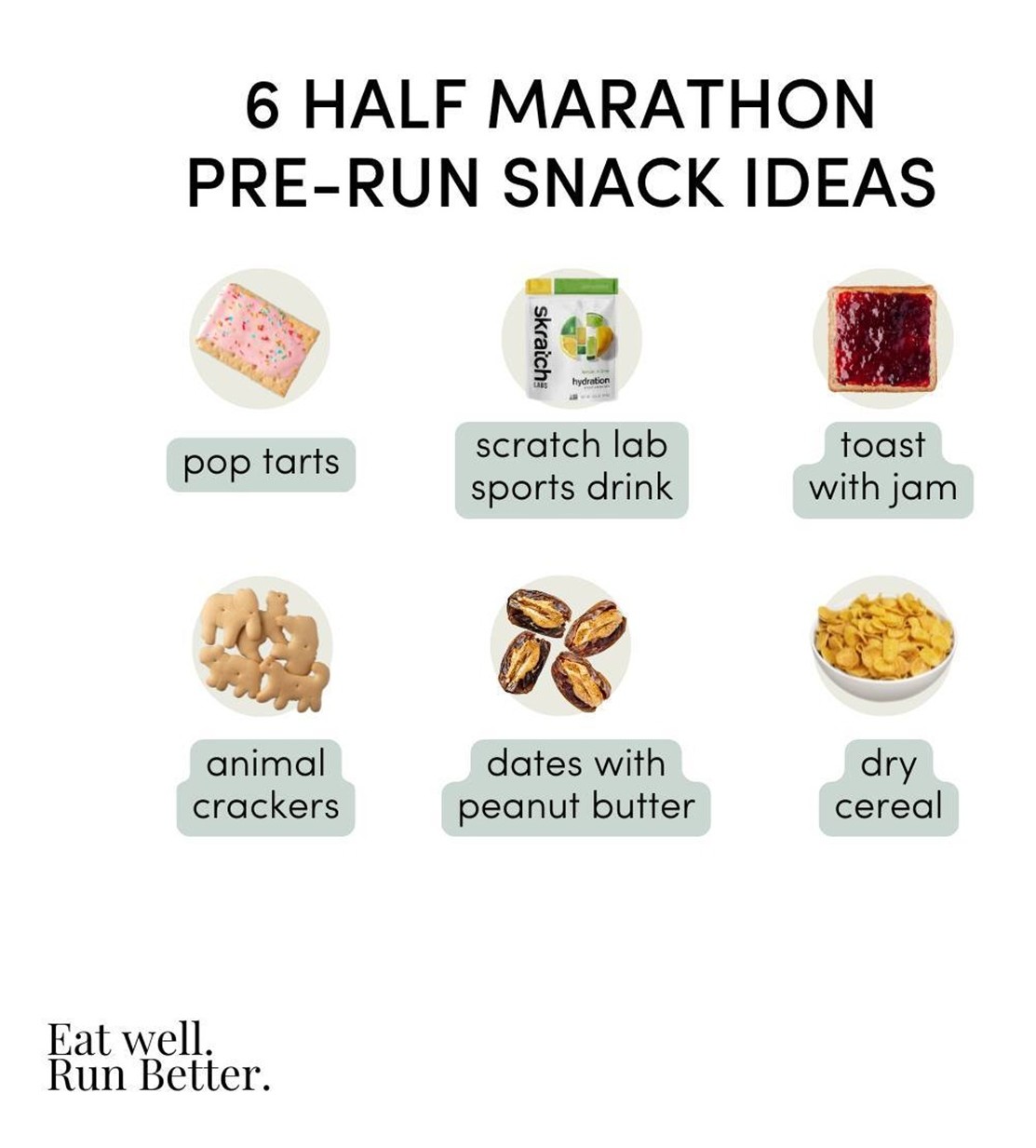
While still in your hotel or home, try having oatmeal with nut butter and berries OR a bagel with 2 tbsp almond butter. Something with a little substance to it.
Goal is .5 to 1 gram of carbohydrate per pound of body weight. It can help to have a little protein or fat with this as noted to help it last longer. But you should have practiced fueling during your long runs to see how food settles in your stomach.
- Bagel or English Muffin with 2 tablespoons of peanut butter, some sliced banana on top
- Sourdough toast with jam and a banana
- Waffles with maple syrup
- Bagel, banana and sports drink
- Oatmeal with honey an berries, a little nut butter (again know how this sits in your stomach)
On the Way to the Race Start
If you didn’t get in a ton for breakfast (and no 200 calories isn’t enough) then try eating a banana (I LOVE the banana wrapped in a tortilla idea above easy to transport and eat on the bus, at the start, etc) or a Clifbar. Again, these are still easy to digest carbs.
**Note: Bananas actually help to soothe the stomach. So not only are they a great carb for fuel, but also if you’re feeling nervous and extra bonus points for the potassium, vitamin C and other good stuff.
I find that slowly munching breakfast or continuing to sip that sports drink works well for many who are dealing with nerves.
Starting Line
When your wave is ready to go eat a Honey Stinger Waffle, one of your favorite energy gels, some Swedish fish, 2 graham crackers – you absolutely want some carbs right then because of that big time gap.
This is going to be about 30 grams of carbohydrates.
And if you are using caffeine for race day, you may choose to use some here. It will take about 45 minutes to peak in your system, so you’ll be getting that boost at a good time.
Looking to try some new gels or snacks for on the run? Check out Fuel Goods, where you can make your fuel box or pick one that’s already put together!
Hydration
Throughout all of this try sipping electrolytes. You don’t want to feel bloated, so just sip consistently. Remember if you start the race dehydrated it’s going to impact your performance. Those electrolytes with sodium are going to have you retaining a little water as well and again, this good for starting well hydrated.
After all of this we’re ready to look at your half marathon fueling strategy! Because remember it doesn’t stop at the start line if you really want to have your best day.
As you prepare to conquer the half marathon, remember that success on race day is not solely determined by the hours of training you’ve invested but also by the careful attention you give to your pre-race nutrition. Fueling your body with the right nutrients at the right times can be the key to unlocking your full potential and achieving your race-day goals.
Timing your meals and snacks strategically, as well as paying attention to hydration needs and electrolyte balance, will further enhance your performance and help you avoid common race-day pitfalls.
Remember that pre-race nutrition is not a one-size-fits-all approach. Experimentation during your training will enable you to discover what works best for your body, allowing you to fine-tune your nutrition plan to suit your individual needs and preferences.
Looking for additional marathon tips?
Other ways to connect with Amanda
Instagram Daily Fun: RunToTheFinish
Facebook Community Chatter: RunToTheFinish
Sign Up to Receive a Weekly Newsletter with Top Running Tips and Laughs



 7 Best Heart Rate Monitors for Running
Leave a Reply