

Picking a marathon goal pace sounds pretty straightforward until you actually sit down to do it.

You can plug a recent race into a marathon pace calculator, look at a pace chart or simply decide you REALLY want that sub 4 finish, but none of those things necessarily mean the pace is right for you.
I’ve seen so many runners throw out goals to “beat Oprah,” qualify for Boston or hit a certain round number when their current training and time to race day just don’t quite match up.
And even when you plug a past race into one of those fun calculators, I’ve found they can be pretty hit or miss on predicting what you can actually do over 26.2 miles.
So instead of picking the finish time first and forcing the pace to match, let’s look at your recent races, training, marathon pace workouts, experience, course and race day conditions to figure out a goal that is challenging, but actually supported by the work you’ve done.
Why You Need a Marathon Goal Pace
Just like choosing the right marathon training plan, setting a marathon pace goal is not about picking a random number that sounds exciting.
Having a target pace gives you something to work toward during training and helps you manage your energy much better on race day.
That becomes especially important in the marathon because even a small difference in pace adds up over 26.2 miles.
A pace that is 10 seconds too fast might not feel like much in the first few miles, but it can change how quickly you are burning through fuel, how much stress you are putting on your legs and how hard the second half of the race becomes.
Having a realistic goal pace also gives you a better way to evaluate your training.
- Are your marathon pace workouts starting to feel more controlled?
- Can you hold the effort longer without your heart rate shooting up?
- Can you take in fuel and still maintain your rhythm?
How to Set Your Marathon Goal Pace
Your marathon goal pace is not one size fits all, which is why I don’t want you picking a number simply because a calculator says you could run it.
Start by looking at your recent race times and training logs to get a realistic picture of your current fitness.
If you’ve consistently been finishing races within a certain range, that gives us a good starting point. If you’ve also made major improvements during this training cycle, then yes, we can start looking at a bigger goal.
The key is finding that balance between pushing yourself and setting a pace that your training actually supports.
1. Start With a Recent Race Result
A recent race result is one of the best places to start because it gives us an actual performance rather than a guess. Ideally we want a half marathon as that is a much better predictor than a 10k and much better than 5K.
A half marathon can be especially useful because it gives us a good look at both endurance and speed. You can take that finish time, plug it into a marathon pace calculator and get an estimated marathon finish time.
But I want you to remember that word: estimated.
A calculator only knows the race time you gave it.
It does not know how much weekly mileage you’re running, whether you completed your long runs, how well you fuel or whether this is your first marathon.
Two runners can have the exact same half marathon PR and still have very different realistic marathon goals.
One may have years of high mileage and marathon experience.
The other may be training for their first marathon on much lower mileage.
Same half marathon time. Very different situation.
2. Look at What Your Training Actually Says
This is probably the part I care about most as a long time running coach.
Your training has been giving you information for months, but you have to pause and pay attention. Look back at your long runs and marathon pace workouts and ask yourself how that goal pace has actually felt.
- Could you settle into it, or did it always feel like you were racing?
- Were you able to hold it later in a long run when your legs were already tired?
- Did your heart rate stay relatively controlled or did it keep climbing quickly?
- Could you fuel and hydrate while holding that pace?
- Did your form stay together?
Early in training, goal marathon pace may not feel easy because you’re still building fitness and endurance. You might be ok with it for a mile here and there, but should not be ready to hold it for long stretches. That’s the whole point of a training cycle!
If your proposed marathon pace consistently feels like threshold work, that’s something we need to consider as a sign that we might be pushing too much in this cycle.
Race day adrenaline is amazing, but it does not magically turn threshold pace into marathon pace.

3. Be Honest About How Training Went
I know this particular point can feel like a buzzkill, but you don’t come here for me to sugarcoat it.
Race day does not erase the previous 16 or 20 weeks.
If training went really well, you consistently hit your mileage, completed your long runs and handled your peak weeks, then you may have every reason to go after the goal you originally set.
But maybe you missed several weeks because of travel, illness or injury.
Maybe you completed most of the training, but every long run felt much harder than expected.
Maybe this is your first marathon and you have never experienced what happens after mile 20.
Those things do not mean you cannot have a great race.
They may mean your best race looks slightly different than the number you picked three months ago.
Long term improvements come from stringing together healthy training cycles, learning from each race and continuing to build.
Sometimes a smart goal this time is exactly what allows you to chase a much bigger goal next time.
4. Use Marathon Pace Miles to Test Your Goal
For some reason, marathon pace miles still get left out of a lot of training plans, and I think they are one of the best ways to figure out whether your goal is realistic.
Early in training, you might only include a few miles at marathon pace.
As your endurance improves, you can start adding longer stretches of race pace into long runs. For experienced runners that could mean 12 miles at goal pace during a 20 mile run, for brand new runners your easy long run pace is your goal pace maybe minus 20 seconds.
The goal is to learn what that pace feels like and see how your body responds when you are no longer completely fresh.
If you can learn the feeling of it that will help you dial in on race day and stress less about your watch. You’ll know if it feels good or if you’re pushing too hard from the start.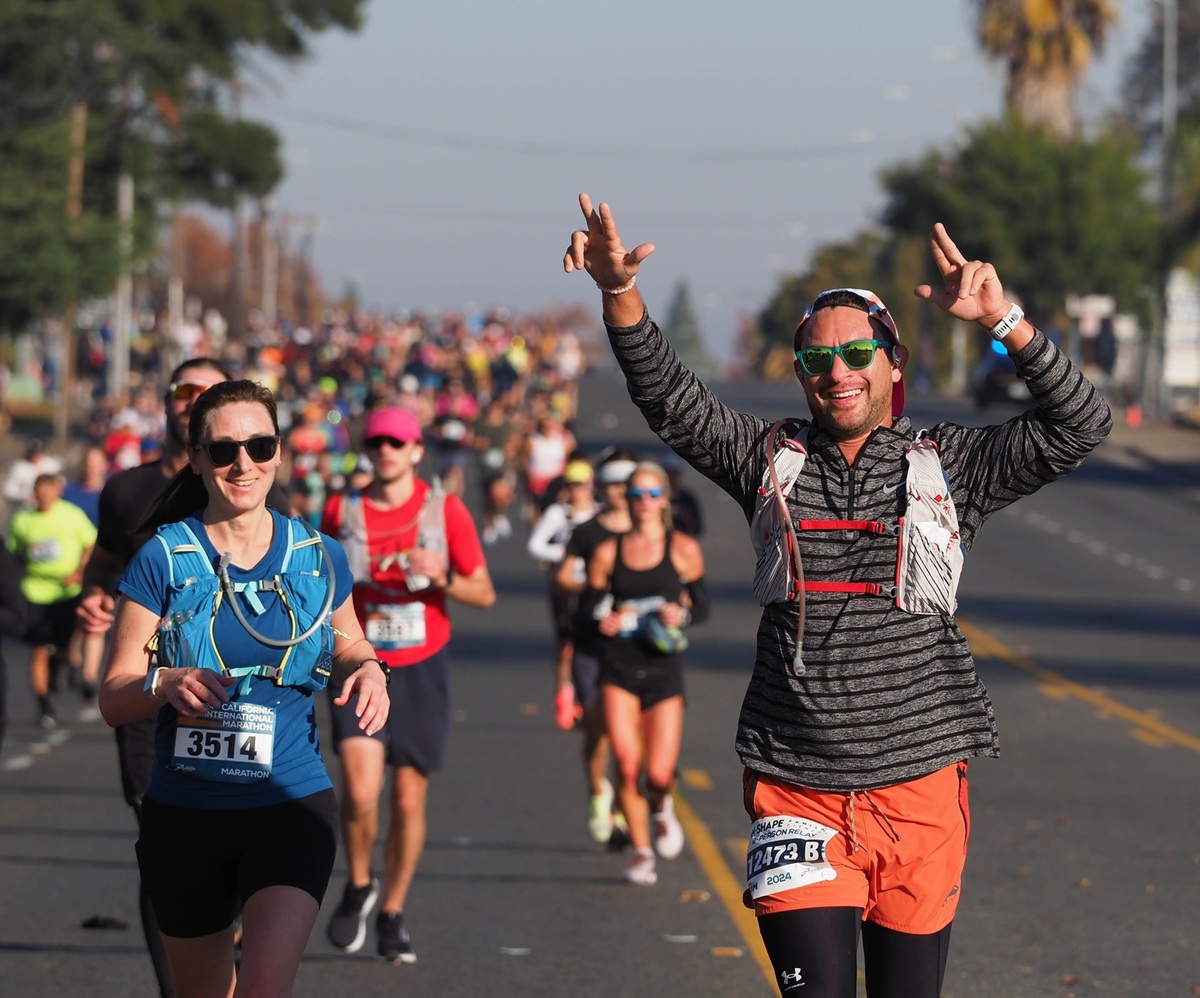
5. Don’t Pick a Pace Just Because You Want the Finish Time
This one sounds obvious, but I see it constantly.
Someone wants to break four hours, so they decide their marathon pace is 9:09 per mile.
But that’s backwards.
9:09 is the pace required to run a four hour marathon. That does not automatically mean it’s your current marathon goal pace. Listen I love a good round number too and I love setting big goals, but I also want you to have a successful training cycle and feel good about what happens on race day.
That means we set the goal based on your training, not just a big dream.
6. Consider Your Marathon Experience
Experience matters a lot for 26.2.
If this is your first marathon, you simply have less information about how your body will respond in the later miles. We want to be a lot more conservative and use your long runs as our best guide of how to pace on race day.
Experienced marathoners know things that are hard to fully reproduce in training. They know what it’s going to feel like when they need to start digging in at mile 18, how their stomach handles a lot of gels and what mental tricks help them in that final push.
Your first marathon gives you a lot of that information.
Then the next training cycle gets even smarter.
7. Consider the Course
The best way to PR is usually a consistent overall effort from start to finish. Obviously a flat course like the Chicago marathon makes that the most possible, while courses like CIM with hills and net downhill require some different planning.
Before setting your marathon pace, look at the actual course.
- Are there long climbs?
- Rolling hills all day?
- A lot of downhill early?
- Big hills late?
- What’s the weather like?
- Are there a ton of turns (that slows you down)
8. Adjust for Race Day Weather
Weather is another thing that can completely change your marathon pace.
We all wish for perfect race day weather, but you cannot control it. Which is unfortunate really, as more of those cool Fall marathons have started to get hotter.
Thus we plan! If race morning is suddenly much hotter or more humid than the weather you trained in, the original goal pace may no longer represent the same effort.
Your heart rate will generally rise faster in warmer conditions because your body is also working to cool itself.
That means the same pace can feel much harder later in the race.
Once the dew point climbs above about 65°F, I want runners thinking more about effort rather than forcing the original number on the watch. Above 70°F, expect the conditions to have an even bigger impact, especially if you have not trained in them.
Wind matters too.
Altitude matters.
Cold rain can matter.
This does not mean abandoning your goals every time the forecast is imperfect.
It means recognizing that race day conditions are part of the equation when deciding what pace makes sense.
9. How Much Should You Trust a Marathon Pace Calculator?
I love data. Give me a marathon pace chart or a calculator and I am perfectly happy to play with numbers.
But marathon pace calculators have limitations. And some of that limitation is that we are humans and not machines. Just because you can run a pace for 13 miles, doesn’t automatically mean in one training cycle you’ll hit the predicted pace for your marathon.
Especially if you aren’t taking in that 60-90 grams of carbs per hour, you’re missing runs, you’re not recovering well.
None of that means you’re a bad runner! It means there are a lot of areas to work on to hit a marathon PR.
Use the predicted time as a starting point, then compare it with what has actually happened during training.
If the calculator says you should be running 9:00 pace but every marathon pace workout says 9:00 feels too hard, I am trusting the training.
10. How to Use a Marathon Pace Chart
A marathon pace chart is another great tool because it tells you exactly what pace you need to average for different finish times.
Let’s say you want to run a 4:30 marathon. The chart will tell you the average pace required to get there.
Then we compare that pace to your actual fitness.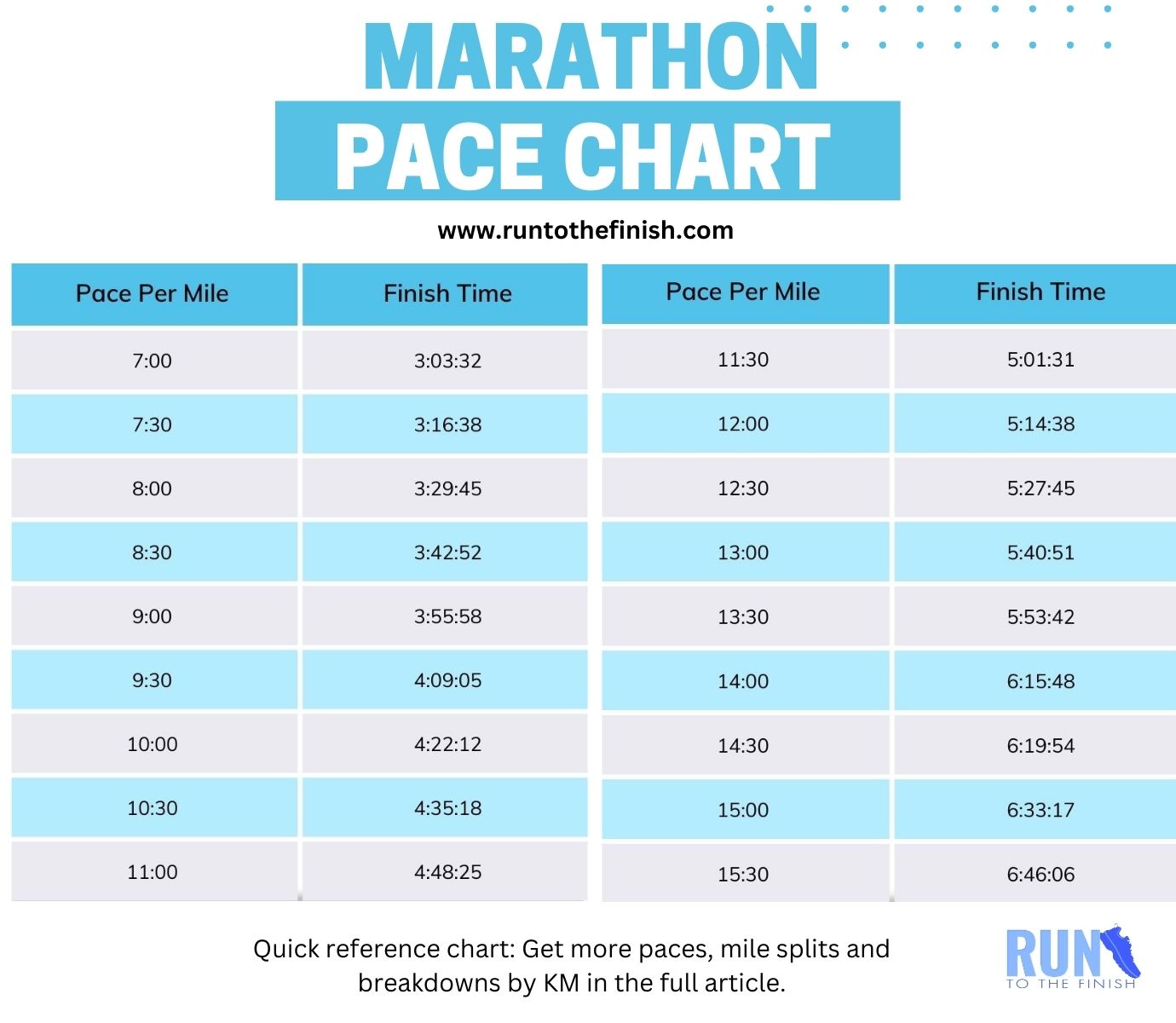
- Have you practiced it?
- Does it line up with recent race performances?
- Can you hold it comfortably during marathon specific workouts?
- Does it still make sense for the course?
- Does it still make sense for the weather?
- If yes, then you probably have a useful target.
11. Should You Set A, B and C Marathon Goals?
I have mixed feelings about the traditional A, B and C time goal setup. Most of us hedge our bets this way because it feels safer.
If the big goal starts looking hard, we already have another one waiting. But sometimes that gives us a little too much room to back away the minute the race gets uncomfortable. And a marathon is going to get uncomfortable.
I prefer goals that have slightly different purposes.
Your primary goal should be the thing that matters most for this race.
- Maybe that is a PR.
- Maybe it is qualifying for Boston.
- Maybe it is finishing your first marathon.
- Maybe you are returning from injury and your biggest goal is simply getting through the race pain free.
Then you can have additional goals that still give the day meaning without using them as an excuse to stop pushing.
In my first race after knee surgery, my biggest goal was finishing pain free.
Once I could tell that was happening, then I could start focusing on the other things I wanted from the day.
That is very different from deciding at mile five that the A goal feels hard, so you are switching to C.
12. Look at Your Timeline
One of the first things to consider when picking a goal is how much time you actually have before race day.
If your marathon is four months away, you still have time to build fitness and see where the training takes you.
If the race is seven weeks away, you’re not going to suddenly create an entirely new fitness level. At that point, most of the work is already done.
This is why I like starting a training cycle with a goal range rather than becoming attached to one exact finish time months in advance.
Maybe you start out thinking 4:15 sounds realistic and by the final month your workouts strongly support 4:05. Great.
Maybe you hoped for 4:00, but the training says 4:15 is going to give you a much better race. Also great.
The goal should become more specific as you collect more information.
13. Be Realistic About Progress In One Cycle
New runners will often see massive gains from one race to the next.
Long time runners may have a fantastic PR by shaving one or two minutes off their marathon time.
Both are progress, but it can come from a lot of different changes.
- Did you increase mileage?
- Add more consistent strength training?
- Finally stay healthy for an entire training cycle?
- Improve your fueling?
- Join a running group that pushed you a little harder?
Those things may all move the needle, but how much is an art form that coaches dive into as we look at your data week after week.
A Simple Way to Choose Your Marathon Pace
If you are still trying to put all of this together, here is the process I would use.
- Start with a recent half marathon race result and plug it into a marathon pace calculator to get a predicted finish range.
- Then compare that predicted pace to what has actually happened during training.
- Look at your long runs, marathon pace workouts, weekly mileage and how well you handled the entire training cycle.
- Next, consider your experience. A first marathon may call for a slightly more conservative goal than your fifth.
- Then look at the actual race course, weather, location.
Finally, choose a marathon pace that feels ambitious enough to be exciting but supported enough that you can explain exactly why you believe you are ready to run it.
Practice Your Marathon Pace Before Race Day
Once you choose your marathon pace, now you need to practice it.
Marathon pacing is a skill. So we work on honing that skill by ensuring you have goal pace workouts spread throughout training then often by doing a tune up race!
Tune up races are ideal for practicing everything about race day including your fueling plan.
Once you have the goal pace figured out, head over to my marathon pacing strategy for exactly how I recommend breaking down the first few miles, the long middle section and that final 10K.



 Marathon Pacing Strategy: How to Pace 26.2 Miles to Finish Strong
Yay! I am so excited for you Coach…can’t wait to read your series!! YOU GO GIRL! FORWARD IS A PACE :)
It’s likely the only pace I’ll have this time around :)
Totally agree with what you’re saying about having an A goal, a B goal and a C goal. That said, there are other ways to build out multiple goals for a race without leaving yourself an out to slack off on training. I try to build in goals to work on not just when I finish, but how I get there. Maybe something as simple as running a negative split or building on your pace with each mile. Something that gets you focused on not just being faster, but also smarter on the course.
That way, if it isn’t your day out there, you have some other good measuring sticks to show how well you did given the circumstances, and hopefully something else to build on for your next race.
Good luck!
Of course tons of ways to set goals.I talk a lot about practice races, which is likely what PHX will be for me. Any race I show up to is a win for me :)
I’m not much of a runner [ok so I dont run at all] but when it comes to setting goals in teh gym I like to keep them small and straight forward. For example, right now I am working to do 5 unassisted pull-ups. I can do two right now, so I have 2 back days planned during the week where I am doing pull-ups and strengthening my back muscles. Hopefully I get there by the end of the year!!
I’m still working on getting to 1 pull up, that’s a 2017 goal!!
LOL beat Oprah goals? Is that really a thing? I’m not a runner (just short little jogs for me) but your post is inspiring me to think outside the box and dig a little deeper to see what I can accomplish fitness-wise next year!
Great goals Amanda! Sometimes we just have to adjust and make goals that work for our bodies. We can only do so much no matter how hard we try. This really hits home for me with the keeping the heart rate down and I look forward to reading all your information as I need to slow down as no matter how hard I try to regulate my breathing and slowing to what I feel is a good pace my heart rate is still way up there. With HIIT and other workouts my heart rate gets up there but recovers quickly. I’ve changed my workouts to work with my body this year but still want to run and I haven’t been able to increase my distance as I would like due to my heart rate. I look forward to following along and learn more from you. I love your 5 ways to reach your goal and a couple are ones I would have never thought of, especially #5.
Such a great post! I am so excited for you! I definitely in the past set goals for myself when I ran more frequently and it totally helped me train harder to get to where I wanted to be! I can’t wait to follow along- 2017 is going to be awesome for you!
Hooray for a big goal! It’s so inspiring and interesting to read about others’ journeys to achieving their goals. Race pace miles are also one of my favorites for reaching a race goal! My goal marathon is this weekend and after that I’ll have a good idea of goals for 2017, but PRing in the half marathon is definitely one of them!
In this baby-having season of life I run between pregnancies as I can…so no PRing for me! But I totally hear you about running at altitude! It’s amazing when I visit my hometown that’s at sea level…I feel like I could run for DAYS! LOL!
Love this post! Goal setting is so important. I love your point about A, B and C goal setting and I couldn’t agree with you more!
I’m so sorry that you are going through these health trials. Sending you all the good energy that I can (C’MON HORMONES). I unfortunately understand at least part of the frustration all too well.
But on the subject of running, this is one of the biggest and most important jobs of the coach (though you don’t need to be a coach to do it). Race pace helps determine workouts and the basis of training–so important!
Always great to have goals that are realistic but still push you. Good luck, sounds like you’re well on your way to reaching yours!
That’s awesome Amanda! Knowing you, you’ll either crush that goal or have fun logging a heck of a lot of miles trying. It’s a win-win either way :)
One of the best thing about a new year is a new fresh start! I look forward to hearing more about your running adventures :)
Great post, Amanda! You always break it down so clearly. Got me thinking about my next races (Philly 10K next month and Philly Marathon in November), which if I’m being honest I have not put much thought into yet 😬
Such a great post! I am so excited for you! I definitely in the past set goals for myself when I ran more frequently and it totally helped me train harder to get to where I wanted to be! I can’t wait to follow along- 2017 is going to be awesome for you!
Most timely post ever! Just getting back to runner after a year long “running sabbatical”. First thing I did was pick a 1/2 marathon in my wheel house, mostly downhill😉. On week 12 of my 18 weeks to prepare and just started learning about race pace, threshold training, etc. can’t wait to read more of you great articles. You’ve definitely inspired me these last few weeks. At 57 and having a half dozen 1/2 marathons behind, my goal is to run a full marathon. Thank you again!
Love hearing that!!! Hope you have a great race, you’re almost to taper now!
Hey Amanda,
I have been chasing a PR of 2.5 for my next race. And just when I needed some motivation, your post came to the rescue :) In the field of running, setting up measurable and realistic goals is quite important. This is truly an admiring post. Thanks a lot for sharing.
Happy Running!
oh thanks so much for the note and I’m so excited for you!!