

Will I lose fitness by taking weeks off after my marathon? When can you start running after a marathon?
It’s a concern for nearly every runner I’ve encountered during post marathon training where we’re battling the post race blues, attempting to run on legs that feel like cinder blocks and craving those runner endorphins…plus throwing in our own weird psychology that the time off means we’re no longer fit.
Did you know that most elite runners take off at least a month post marathon? (Here are some other facts about running.)
They don’t expect to maintain peak fitness year round and neither should you!
Let’s talk about how to not lose the gains you’ve made, reclaim your motivation without that massive goal and keep running strong. Your post marathon training plan is going to require some patience and maybe even a little shift in your focus. We talk a LOT about how to build up to the marathon. The long runs, the pre-race meals, the hip work, but what happens after the big day? Ok fine, I’ve covered the immediate post race recovery, but let’s look at the weeks beyond that.
I can’t lie one of the reasons I limit myself to 1 marathon a year and often say I won’t do them is the 2-3 weeks of no running after a race.
It’s completely necessary and I think that break helps remind us why we love running.
But it’s also an INTERRUPTION to what has become a really good habit. Suddenly you don’t have to get up early to run and those weekends of sleeping in start to feel really wonderful.
I fully believe the wrong post marathon training is often to blame for people doing one marathon and done! They lose the habit and with that goes the motivation, the drive.
Now let’s move on to the question at hand…will you lose fitness and how do you stay sane when you really want to go for a run?
4 Reasons You Need Weeks Off Running After a Marathon
It’s definitely a shock to think you feel good and have energy then attempt to run and feel like your body is going to come apart at the seams. As though you can actually see the wheels falling off and are wondering if the emergency feature on your phone really works.
Post Honolulu, Jodi texted me nearly daily asking if it was ok to run yet. And I patiently said no, repeatedly. Finally I agreed that she could test it out, but I warned her…oh did I warn her.
She reported back that it was categorically awful and mind blowing and why the hell didn’t anyone say that recovery was going to be so hard! “I had no idea how tough it would be. I knew it wouldn’t be easy but this shocks me. “
It’s so true..the aftermath.
What’s happening to your body in those days post marathon?
Every step you take is the equivalent force of 2-3 times your bodyweight, and it’s estimated you’ll finish the race two cm shorter than you were at the start.
No seriously, read that again… you actually finish shorter! Does that give you a better idea of the pounding your skeleton is taking and your muscles to hold it all together?
#1 DOMS Will Catch You By Surprise
Delayed onset muscle soreness usually starts one to three days after hard physical activity and is part of the bodies recovery process, not lactic acid as previously believed. This is why you suddenly can’t get up after sitting down on the toilet “ahhh my quads!”
Some runners believe that taking a short run the day after the marathon helps with this, but most folks I know are too damn tired. Running the day after a marathon is going to be a personal preference, but I generally say don’t do it.
Instead follow my post race guide tips for taking walks…yes walks.
You’ve got the medal to prove your a runner, no one will take away your status for walking.
Then review these 11 tips to help with muscle soreness from running >>

#2 Inflammation Needs to Be Addressed
The rest phase is important to allow inflammation caused by muscle tears and stress (physical and emotional) of the race to begin dissipating. Hence the overall body fatigue you might feel as all your bodily resources are trying to get you back to homeostasis.
Once you’ve enjoyed that post race splurge meal, it’s time to get back to all the anti-inflammatory foods and keeping your activity chill for awhile.
Consider nutrition a big part of your post marathon training! That will give you something to focus and for many of you help to alleviate fears that you are going to gain weight from not running.
Remember that your weight may have gone up due to the race!
#3 Dehydration Lingers Post Race
No matter how much you try to hydrate during the race, most still come away somewhat depleted and the recovery phase is a time for muscles, digestion and everything to recuperate.
Dehydration will make you feel sluggish and could cause muscle cramps.
Don’t forget that your electrolytes remain important post race as well, to help fully replenish those muscles.
#4 Ouchies Need to Heal
For lack of a technical term this encompasses the blisters, chaffing and potential lost toenails that are going to make your attempts at running painful. Just because you want to run, doesn’t mean it’s a good idea!
Blisters that keep getting popped can lead to infections…chafing that just keeps rubbing becomes unbearable even when not running.
So step 1 let’s make sure your body is back in working order for post marathon training.
- How to prevent and treat black toenails from running
- Preventing and treating running blisters
- Best Anti-Chafing Creams
Post Marathon Running Plan
A traditional rule of thumb was you should take 1 day off running for every mile of a race. This often works well for newer runners whose bodies have so much more rebuilding and repairing to do.
But most runners have a mild meltdown thinking about that much time off.
Instead, this is the process that we use with our athletes:
- 7 days minimum no running for everyone
- 10 days no running for those who didn’t end up going all out or who have been training injury free for at least a year
- 14 days no running for those who hit a big PR and for new runners
After we get past the two week mark, it’s about developing a really good comeback plan for training after a marathon. That could depend on your goals, upcoming races and simply how the body feels.
I love these two thoughts from Meb for Mortals because I fully agree:
- most runners should be able to take off at least 3 weeks without any loss in fitness gains
- don’t allow this to become a break in your training, just a shift
Run 1:
This is a trial run to see how your muscles feel. The legs may not feel fresh and springy, but if nothing hurts this could be up to 30 minutes. It may go best as a run/walk.
Run 2:
A day or two later, you can try another 30 minute easy run. Again this is SUPER easy, like a recovery run. Again if there is any pain, this run is stopped. You go do some additional strength work and walk for a few more days.
Run 3, 4, 5: Continuing to keep all the miles easy and generally alternating running days, as you pay attention to how your body feels.
For at least 3 weeks, we generally recommend keeping all runs easy. Maybe some strides in week 3. This is going to vary by the experience level of the runner.
But as noted elites, are really relaxed about the weeks after a marathon because they know that recovery now means less chance of an injury later (particularly a stress fracture).
Strength Training After Marathon
My preference for most runners is to use the weeks after 26.2 miles to refocus on strength training and mobility.
Week 1:
You’re going to avoid much leg work here, but as soon as your energy feels good you can dive in to upper body and core workouts. This week you may opt for body weight focused workouts or lighter weights, as there is still muscle damage.
Week 2:
Many runners are feeling more energetic this week and able to go back to some heavier lifting. While the lower body may be sore, you could find some benefit from some light bodyweight movements. Upper body and core work may start to focus on less reps at a higher weight.
Week 3:
You should be ready to return to full body lifting with heavier weights. But if you’re noticing pain or a big drop in energy that’s a signal from the body you aren’t recovered and need to back off.
If you need a place to start, check out our strength training for runner programs >>
Great now, you have the knowledge to talk yourself down when you start getting itchy to run before you should! So let’s give your brain some other ways to embrace the running break.
Post Marathon Training Guide
You should not expect to maintain marathon fitness year round. You may quite easily maintain a high level of fitness and be able to plenty of long runs, but that PEAK fitness you experience for the race is just that. Peaking.
It’s not designed to be something you maintain all the time.
If you followed a great training plan for the marathon and didn’t simply wing it or endure months of injuries prior to the race, you should come out of it with a very strong training base.
Which means a very strong cardiovascular system, strong muscles and some mental fortitude.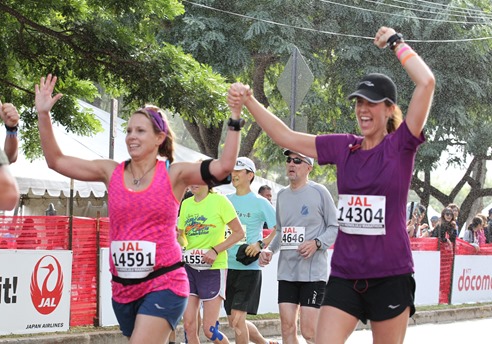
Post Marathon Running Plan
You’ve developed a routine, a habit that’s now just part of your life.
You make time for runs, you fuel right, you stretch, you foam roll…if you stop all of these for 2-3 weeks, can you imagine how hard it will be to start again?
Don’t tempt fate. Keep moving…just not running.
This is your chance to correct anything you neglected, like mobility or foam rolling or even fueling!
Keep a Schedule
Get up at the same time. Exercise at the same time you used to run. Maybe it’s a walk or just foam rolling, but keeping the habit alive will make it easier to either cross train or come back to running when ready.
[bctt tweet=”You must rest post-marathon, but that doesn’t mean losing fitness. Tips to stay on track! ” username=”runtothefinish”]Build a Stronger Foundation
Really and truly this piece is the key to maintaining your fitness…doing things besides running.Enjoy walking, swimming, yoga, checkout these strength training for runner workouts, work your upper body!
Now is when you can finally commit to some time for all the cross training that you so skillfully ignored during those big marathon training weeks. By focusing on strength training, core work and mobility now, you’ll go in to your next round of training stronger.
In fact, a few different studies have shown us that by creating the muscle first, you’re more likely to maintain more of it during marathon training which often leads those coveted six pack abs.
Motivate Yourself
Ok so you can’t have the running endorphins, but you can still get psyched about your return to running and keeping that spark alive is going to help.
- read books on running or athlete biographies or blogs
- jump on Instagram and cheer for others
- start thinking how this time is going to make you a better runner
Relax the Drive
Don’t expect to feel or run the same way you did during training right way. Allow yourself to build back!!
I swear this is the way so many runners get injured. You ran an 8 minute mile on race day, so suddenly that should be your new easy pace…nope. Remember the build up to that day, you’re always going to need that process to get stronger and stay injury free.
This is your chance to put aside the clock and remember exactly why you love running…and put together a plan to make your next race even better.
Enjoy your cross training time and allow yourself to ease back in to intense training with the knowledge that while it might be hard at first you haven’t actually lost anything.
All right I hope this gave you some ideas for how to look at post marathon training!
Looking for marathon training tips?
- Marathon Pace Chart
- Why is a marathon 26.2 miles?
- What’s the Best Marathon Training Plan?
- How long to train for a marathon?
Other ways to connect with Amanda
Instagram Daily Fun: RunToTheFinish
Facebook Community Chatter: RunToTheFinish
Get more running tips: Pinterest



 Nike Pegasus Trail 4 Review: Comparing Trail Running Shoes
Leave a Reply